
The Problem Nobody Warns You About Until Match Day
Most people assume that if their IPTV service carries 4K channels, they are automatically set for the 2026 FIFA World Cup. That assumption has caused more headaches than almost any other single mistake we have seen in this industry.
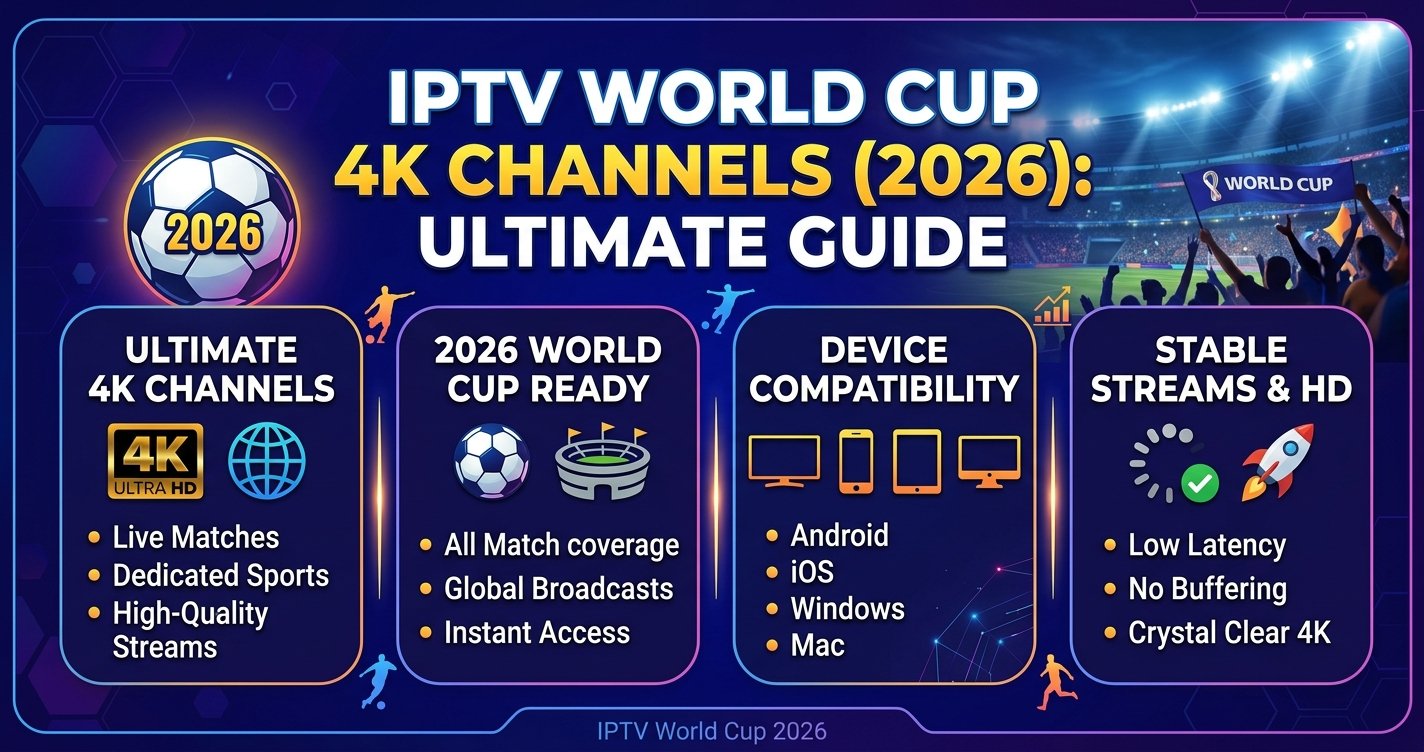
IPTV with World Cup 4K channels in 2026 is genuinely possible, and millions of viewers will watch the tournament this way. But whether your experience is seamless or a disaster depends entirely on preparation, not the channel list on your provider’s dashboard.
The short answer is this: if your IPTV service is running on a properly engineered infrastructure with multi-uplink redundancy, traffic load balancing, and CDN-backed 4K delivery, you will watch the 2026 World Cup in stunning quality. If it is not, you will be watching a buffering spinner when Mbappé scores in the 89th minute.
The rest of this article explains exactly how to tell the difference before the tournament starts.
What “4K” Actually Means on an IPTV Service
This is where a lot of confusion begins. The word “4K” on an IPTV channel list is not a quality guarantee. It is a label.
A channel marked 4K on a UK IPTV reseller panel may be delivering true 2160p UHD at 25–50 Mbps with HDR support, or it may be an upscaled 1080p stream wearing a 4K badge. These are fundamentally different things, and the average subscriber cannot tell the difference from the channel list alone.
Genuine IPTV with World Cup 4K channels in 2026 requires the broadcaster to originate a true 4K feed. FIFA has confirmed 4K production for the 2026 tournament, and select broadcasters including Canal+, beIN Sports, and Sky will distribute genuine 4K. The question is whether your IPTV service is sourcing from those exact feeds or relabelling HD content.
How to check before the tournament:
- Ask your provider which broadcaster originates the 4K feed
- Check the stream bitrate on your player (VLC shows this under Tools > Media Information)
- Compare picture quality on fast-motion scenes — upscaled content blurs on rapid panning shots
- Genuine 4K streams will require 25–50 Mbps sustained bandwidth at your device
Pro Tip:
A real 4K stream at 50 Mbps will visibly stress a cheap router during playback. If your IPTV service offers “4K” channels and they load exactly as fast as your 1080p channels with no additional buffering, they are almost certainly not true 4K.
Why 4K IPTV Performance Collapses During Major Sports Events
This is the part experienced operators know and most subscribers do not. Watching IPTV with World Cup 4K channels on a random Tuesday evening tells you almost nothing about how the service will perform during a live World Cup final.
During a major sporting event, every subscriber on the platform is watching simultaneously. This is called concurrent load, and it is the single biggest infrastructure stress test an IPTV service will ever face.
We have seen well-regarded services with 50,000 subscribers completely fall over during Champions League finals. Not because their infrastructure was poor on paper, but because their uplink capacity was sized for average concurrent load, not peak concurrent load. The 2026 World Cup final will be a peak load event unlike almost anything else.
A service that streams IPTV with World Cup 4K channels to 10,000 simultaneous viewers needs to sustain somewhere between 250 Gbps and 500 Gbps of clean outbound bandwidth for the 4K streams alone, depending on bitrate. Most cheap IPTV services have nowhere near that capacity.
| Infrastructure Factor | Underprepared Service | Properly Engineered Service |
|---|---|---|
| Uplink capacity | Sized for average load | Sized for 2x peak load |
| CDN usage | None or single CDN | Multi-CDN with geo-routing |
| Failover system | Manual or none | Automatic with sub-60s recovery |
| Load balancing | Single server | Multi-server with traffic distribution |
| Monitoring | Reactive | Active real-time alerting |
| 4K bitrate delivery | Inconsistent | Sustained 25–50 Mbps per stream |
How ISP Throttling Will Affect 4K Streams During the Tournament
This is a 2026-specific issue that did not exist in the same form during the 2018 or 2022 tournaments. ISPs in the UK, USA, Canada, and Australia have deployed significantly more sophisticated traffic fingerprinting technology in the past two years.
AI-driven traffic analysis can now identify HLS video streams with high confidence based on packet timing, burst patterns, and payload signatures — even on encrypted connections. During the 2026 World Cup, ISP throttling of unrecognised high-bitrate video traffic is a genuine risk, particularly in markets where regulatory pressure on unlicensed content is increasing.
IPTV with World Cup 4K channels in 2026 will be most stable on services that actively use traffic obfuscation, DNS routing diversity, and CDN masking to avoid fingerprinting. This is not a theoretical concern — we noticed unusual ISP behaviour during last year’s Champions League quarter-finals where multiple services reported 4K degradation specifically between 8 PM and 11 PM in UK residential areas.
What you can do as a subscriber:
- Use a reputable VPN with split tunnelling configured for your IPTV app
- Avoid VPNs that bottleneck bandwidth below your 4K stream requirement
- Test your VPN connection speed before the tournament — you need 50+ Mbps stable with VPN active for genuine 4K
- Ask your IPTV provider whether they use CDN masking or DNS diversity
What IPTV Resellers Need to Know Before the World Cup
For any IPTV reseller operating a customer base in 2026, the World Cup is simultaneously the biggest commercial opportunity and the biggest operational risk of the year.
A reseller panel with 500 active subscribers might seem perfectly manageable during normal operations. The moment those 500 subscribers all start watching IPTV with World Cup 4K channels simultaneously, you are processing five times your normal concurrent load on that single 4K stream alone.
One reseller we worked with lost nearly 200 subscribers following a catastrophic service failure during the 2022 World Cup group stage. Their provider had not communicated uplink limitations, their reseller panel showed no warning signs until match day, and by the time they raised a support ticket the match was already over. Customers left, and many did not return.
Pro Tip:
As an IPTV reseller, your reputation is tied directly to your provider’s infrastructure, not just your customer service. If your provider cannot demonstrate scaled capacity for peak events, find one that can before the 2026 World Cup starts — not during it.
Pre-tournament reseller checklist:
- Confirm with your provider their uplink capacity for peak concurrent load
- Request information on their CDN and failover setup for 4K streams
- Check that your reseller panel shows real-time stream health or status
- Run a stress test using trial accounts during a lower-stakes sports event
- Ensure your sub-reseller network is using the same provider infrastructure
Bandwidth Reality Check: Can Your Home Network Handle 4K IPTV?
One consistently overlooked failure point for IPTV with World Cup 4K channels is the home network itself. The IPTV infrastructure can be flawless, but if your broadband connection or home Wi-Fi is the bottleneck, the 4K experience will still fail.
Minimum requirements for stable 4K IPTV:
- 50 Mbps sustained downstream speed (not peak)
- Latency below 30ms to the stream server
- Wired Ethernet connection preferred over Wi-Fi for 4K
- Router capable of handling sustained high-throughput sessions
- No bandwidth-intensive background processes during the match
The 50 Mbps figure is not a guideline — it is the floor. During a 4K World Cup stream at high bitrate you will be consuming the full bandwidth of a 50 Mbps connection. If other devices in the home are also active, you need headroom above that.
Wi-Fi 5 GHz performs well for 4K IPTV in most home environments, but physical obstacles, neighbouring interference, and router distance all introduce real-world degradation. For a match as important as a World Cup final, a wired connection is strongly recommended.
Pro Tip:
Run a speed test directly on your streaming device — not your phone — at the time of day you plan to watch the World Cup. Evening peak hours often reduce available bandwidth by 20–40% on residential connections even with fibre.
Device Compatibility for IPTV with World Cup 4K Channels
Not every device that runs an IPTV app is capable of decoding a genuine 4K stream efficiently. This is a hardware limitation, not a software issue, and it catches a significant number of subscribers by surprise.
Device compatibility summary for 4K IPTV:
| Device | 4K IPTV Support | Notes |
|---|---|---|
| Amazon Firestick 4K Max | Yes | Recommended for IPTV 4K |
| Nvidia Shield Pro | Yes | Best-in-class IPTV 4K performance |
| Apple TV 4K (3rd Gen) | Yes | Requires compatible IPTV app |
| Android TV Box (S905X4+) | Yes | Check chip generation |
| Samsung Smart TV (2020+) | Yes | Via IPTV Smarters or Tivimate |
| Standard Firestick (1080p) | No | Cannot decode 4K |
| Older Android Boxes | No | Many lack 4K decode hardware |
| Mobile Phones | Limited | Battery and thermal throttling issue |
The processor chip matters significantly. An Android TV box running an Amlogic S905X4 or S905X5 chip will decode 4K IPTV streams well. Earlier generations including S905X and S912 struggle with true 4K at sustained high bitrates and will drop frames or stutter under load.
How to Evaluate Whether a Provider Is Ready for 2026 World Cup 4K
After reviewing hundreds of support requests from subscribers and resellers, a clear pattern emerges. The services that fail during major tournaments almost always show warning signs in advance. The resellers and panel owners who check for these signs early avoid the disasters entirely.
Pre-World Cup provider evaluation checklist:
- Does the provider have documented multi-CDN delivery?
- Can they confirm 4K stream sources from verified broadcasters?
- Do they offer a guaranteed SLA or uptime commitment for sports events?
- Is there a status page or monitoring dashboard visible to resellers?
- Have they handled a previous major sporting event without widespread outages?
- Do they communicate proactively before major events?
Providers who cannot answer these questions clearly are not ready for IPTV with World Cup 4K channels in 2026 at scale. That is not speculation — it is a pattern we have seen repeatedly across infrastructure reviews.
For UK IPTV resellers and sub-resellers looking to align with infrastructure that has demonstrated reliability during peak sports events, britishseller.co.uk provides reseller panel access backed by infrastructure specifically engineered for high-concurrency sporting events.
FAQ
What is IPTV with World Cup 4K channels in 2026?
IPTV with World Cup 4K channels in 2026 refers to watching the FIFA World Cup via an internet-based TV service that delivers the broadcast in 4K Ultra HD resolution. This requires a provider sourcing genuine 4K feeds from authorised broadcasters such as Sky, beIN Sports, or Canal+, combined with sufficient infrastructure to sustain high-bitrate delivery during peak concurrent viewing.
How much internet speed do I need for IPTV with World Cup 4K channels?
You need a minimum sustained 50 Mbps download speed on your streaming device for stable IPTV with World Cup 4K channels. Peak speed tests are insufficient — test at the time of day you plan to watch. Evening hours typically see bandwidth reductions on residential connections. Add headroom if other devices share the same connection during matches.
Will IPTV services buffer during World Cup matches in 2026?
Poorly prepared IPTV services will buffer significantly during World Cup matches, particularly 4K streams. The 2026 tournament will generate concurrent viewing spikes that stress underprepared infrastructure. Services with multi-CDN routing, load balancing, and scaled uplink capacity are far less likely to buffer during peak events.
What devices support IPTV with World Cup 4K channels?
Compatible devices include the Amazon Firestick 4K Max, Nvidia Shield Pro, Apple TV 4K (3rd generation), newer Android TV boxes with Amlogic S905X4 or later chips, and Samsung Smart TVs from 2020 onwards. Standard 1080p Firesticks and older Android boxes typically cannot decode genuine 4K streams reliably.
How do IPTV resellers prepare for World Cup 4K traffic?
IPTV resellers should confirm their provider’s peak concurrent load capacity well before the tournament. Resellers should stress-test streams during lower-stakes events, verify CDN and failover setup, check that their reseller panel provides stream health monitoring, and ensure their sub-reseller network is aligned with the same stable infrastructure.
Is VPN necessary for watching IPTV with World Cup 4K channels?
A VPN is not strictly necessary but is strongly recommended in markets where ISP throttling of high-bitrate video traffic is common. The UK, US, Canada, and Australia are all markets where traffic fingerprinting has increased significantly. Use a VPN capable of sustaining 50+ Mbps with minimal latency overhead. Test it before match day.
Why does 4K IPTV work on weekdays but fail during live matches?
Weekday viewing reflects low concurrent load. During a live World Cup match, concurrent viewers spike dramatically and infrastructure reaches capacity. A service that performs flawlessly with 200 concurrent viewers may completely fail with 5,000 simultaneous connections on the same 4K stream. This is the single most common cause of sports event streaming failures.
What should sub-resellers check before recommending IPTV for the World Cup?
Sub-resellers should verify with their panel owner or IPTV operator that the upstream infrastructure has documented peak-event capacity, real 4K source feeds, and a failover system. Recommending a service to customers before stress-testing it during a comparable sports event is the fastest way to lose those customers permanently after a World Cup failure.
Success Checklists
Subscriber Checklist
- Test sustained download speed on your streaming device at peak evening hours
- Confirm your device supports 4K hardware decode (check chip generation for Android boxes)
- Switch to wired Ethernet for match day if possible
- Install and test your VPN before the tournament — verify 50+ Mbps through VPN
- Ask your provider which broadcaster originates the 4K feed
- Check your IPTV app supports 4K playback (Tivimate, IPTV Smarters Pro)
- Run a test stream during a lower-profile sports event before the World Cup
Reseller Checklist
- Confirm your provider’s uplink capacity for peak concurrent load in writing
- Verify CDN setup and failover system before the tournament starts
- Stress-test 4K streams during a pre-tournament sporting event
- Check your reseller panel for real-time stream health monitoring
- Prepare a customer communication plan for any potential disruptions
- Review your trial conversion strategy ahead of the subscriber surge
- Ensure panel credits and capacity are sufficient for a subscriber volume increase
Sub-Reseller Checklist
- Verify with your panel owner that the upstream provider has documented peak-event infrastructure
- Test 4K stream quality personally before recommending to customers
- Avoid onboarding large customer batches immediately before major matches
- Establish a clear support escalation path with your IPTV operator before match day
- Do not oversell capacity relative to your panel allocation during peak events
- Communicate proactively with customers about device and bandwidth requirements
Conclusion
IPTV with World Cup 4K channels in 2026 represents a genuine leap in sports viewing quality — but only for subscribers and resellers who have done the preparation work in advance. The technology exists, the broadcaster feeds are real, and the infrastructure capable of delivering them at scale does exist. The gap is always between what a provider promises and what they actually deliver when 50,000 subscribers hit play simultaneously.
The 2026 FIFA World Cup will be watched by hundreds of millions of people. A significant portion of them will be using IPTV. The ones who prepared — who verified their provider, tested their devices, confirmed their bandwidth, and stress-tested their setup — will enjoy one of the most impressive home viewing experiences ever available. The ones who assumed it would work will know the result only when the buffering starts.
Closing Insight
The biggest lesson from every major sporting event failure we have witnessed is that problems are always visible in advance — they are just ignored until they are expensive. IPTV with World Cup 4K channels rewards preparation and punishes assumptions. Run your tests now, ask your hard questions now, and make your infrastructure decisions now. By the time the first whistle blows, it is already too late to fix what you should have checked three weeks earlier.