
Nobody talks about this enough: the fastest way to kill your UK IPTV reseller income isn’t buffering. It’s a frozen payment account.
You could have 400 active subscribers, a rock-solid panel, and zero downtime, and still wake up one morning to a Stripe termination email, a PayPal permanent hold, or a WorldFirst compliance review that locks your balance for 90 days. IPTV payment methods are arguably the most fragile part of this business, and most resellers treat them as an afterthought.
They shouldn’t.
In 2026, payment processors have gotten smarter, more aggressive, and considerably less forgiving. This guide covers every practical IPTV payment method a serious UK IPTV reseller needs to know, not the watered-down version, but the full operational picture including risk exposure, chargeback vulnerabilities, and what diversified payment stacks actually look like at scale.
Why Standard Payment Processors Keep Rejecting IPTV Businesses
Before you pick your IPTV payment methods, you need to understand why so many processors reject this industry in the first place. It’s not random.
Payment networks, Visa, Mastercard, and the processors sitting on top of them, maintain internal risk category lists. IPTV services, particularly subscription-based streaming resellers, frequently land in high-chargeback verticals. Even legitimate resellers get flagged because the industry shares category codes with services that have historically generated disputes.
The triggers vary, but recurring themes include:
- Subscription billing that customers dispute after cancellation
- High international transaction volume across multiple currencies
- Business descriptions that mention “streaming,” “channels,” or “live TV”
- Spike-pattern revenue (common during sports seasons)
Pro Tip: When registering a payment account, your business description matters enormously. “Digital media access services” or “cloud-hosted content delivery” passes compliance screening far more consistently than anything mentioning IPTV, channels, or streaming directly.
The smart play isn’t to fight this, it’s to build a payment infrastructure that routes around it entirely. That means thinking in layers: primary processor, backup processor, crypto channel, and direct bank transfer for high-value clients.
The Real Cost of Relying on a Single IPTV Payment Method
Most resellers start with one processor and never diversify. That works until it doesn’t, and when it breaks, it breaks catastrophically.
Consider the typical failure scenario: a reseller running £8,000/month through a single PayPal business account gets hit with a hold after a cluster of chargebacks during a major sports event weekend. The entire balance is frozen pending review. Renewal invoices go unpaid. Subscribers churn. Panel credits dry up because the upstream supplier isn’t getting paid.
This isn’t a hypothetical. It’s a pattern that repeats constantly across the reseller space.
The core issue with IPTV payment methods isn’t which one you choose, it’s how many you have active simultaneously. Resilience requires redundancy.
A functional 2026 payment stack for mid-level IPTV resellers looks like this:
| Layer | Method | Best for | Risk level |
|---|---|---|---|
| Primary | WorldFirst / Wise Business | Multi-currency, EU/UK clients | Low-Medium |
| Secondary | Crypto (USDT/BTC) | Tech-savvy clients, no chargeback risk | Low |
| Tertiary | Direct bank transfer | High-value B2B resellers | Very Low |
| Fallback | Payment links (SumUp/Square) | Low-volume or new clients | Medium |
| Emergency | Payoneer | International payouts | Medium |
This isn’t theoretical, it reflects what operational resellers running multiple storefronts actually use when one channel goes down.
Cryptocurrency: The Most Underused IPTV Payment Method in the Reseller Space
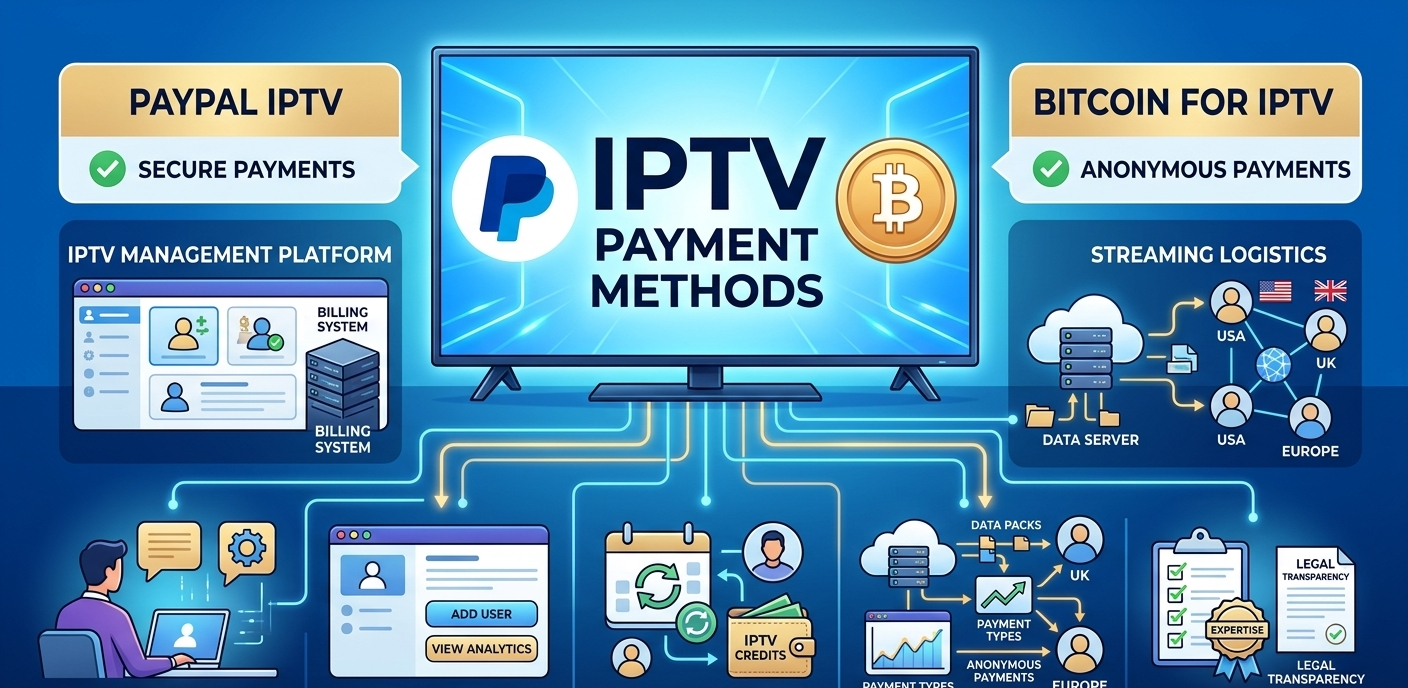
Crypto remains the most consistently reliable of all IPTV payment methods for one simple reason: there are no chargebacks. Once a USDT transaction hits your wallet, it’s final. No dispute windows, no processor intervention, no frozen balances.
Adoption has increased sharply in 2026 among resellers serving European and Middle Eastern markets. Clients in regions with limited banking infrastructure or strong privacy preferences, UAE, parts of Eastern Europe, Pakistan, increasingly prefer settling invoices in stablecoin.
Practically speaking, most resellers accept:
- USDT (TRC-20 or ERC-20): lowest fees, widest adoption
- Bitcoin (BTC): preferred by older, privacy-conscious clients
- USDC: growing in EU markets due to regulatory compliance optics
Pro Tip: Always quote crypto invoices in USD equivalent with a 2-hour rate lock window. Stablecoin-to-stablecoin transfers eliminate volatility entirely, but if a client insists on paying BTC, lock the rate at invoice time and convert to USDT immediately on receipt.
The friction point is onboarding clients. Many retail subscribers are unfamiliar with wallets. Fix this by keeping a short, visual step-by-step payment guide, four screenshots maximum, that you send with the invoice. Conversion rate on crypto invoices jumps significantly when you reduce the cognitive load on the client side.
How Multi-Currency Accounts Changed the Game for UK-Facing Resellers
For resellers targeting UK and European markets specifically, multi-currency accounts through providers like WorldFirst or Wise Business are arguably the most important IPTV payment method development in recent years.
The operational benefit is obvious: you receive GBP from UK clients, EUR from European clients, and AED from UAE-based IPTV resellers, all into a single account dashboard, with local account details in each currency. No currency conversion fees on receipt. No international wire delays.
What’s less obvious is the compliance structure. WorldFirst, for instance, operates as an FCA-regulated entity. That regulatory framing makes the account more durable than a standard PayPal Business account, which can be suspended unilaterally and without detailed explanation.
Practical setup considerations:
- Use a registered company name (SECP, Ltd, or equivalent), not a personal account
- Ensure your stated business activity is generic enough to pass review
- Maintain clean transaction patterns, avoid erratic spikes without supporting documentation
The verification process has tightened in 2026. Expect requests for utility bills, business registration certificates, and proof of client relationships during onboarding or periodic reviews.
Chargeback Warfare: The Silent Killer of IPTV Payment Accounts
Chargebacks don’t just cost you money, they cost you your payment account entirely if the ratio climbs above 1%. That’s Visa and Mastercard’s threshold for flagging a merchant as high-risk, and processors act before you even know it’s happening.
The IPTV chargeback problem is structural. Subscribers cancel mentally but forget to cancel formally. Others dispute charges hoping to get a free month. During major sports blackouts or downtime periods, dispute volume spikes dramatically.
Mitigation isn’t optional if you’re processing card payments as one of your IPTV payment methods. Here’s what actually reduces chargeback rates:
- Explicit subscription terms on every invoice and confirmation email, no ambiguity about auto-renewal
- Clear cancellation instructions, make it easy, because difficult cancellation generates disputes
- Proactive refund policy, offer a partial credit rather than fighting a chargeback you’ll likely lose anyway
- Transaction descriptors, ensure your billing descriptor reads something recognizable, not a cryptic company abbreviation. Confused customers dispute first, ask questions never.
Pro Tip: Every chargeback you win still counts against your ratio in most processor systems. The goal isn’t to win disputes, it’s to have so few disputes that your ratio never becomes a conversation.
B2B Panel Sales and the Invoice-Based Payment Model
Sub-reseller relationships operate differently from retail subscriber billing. When you’re selling panel credits wholesale to other resellers, card processing becomes less relevant and invoice-based payment becomes the primary IPTV payment method.
This is actually a lower-risk structure. Bank transfers carry no chargeback rights. Crypto settlements are final. And the volume per transaction is higher, meaning fewer transactions to manage overall.
B2B reseller payment workflows that hold up at scale:
- Issue formal invoices with your registered company name, VAT number (if applicable), and itemised credit breakdown
- Offer 24-hour payment windows for credit top-ups, urgency reduces payment delays
- Build a tiered pricing model: larger credit purchases unlock better per-credit rates, incentivising upfront payment
- Use a dedicated business account for B2B transactions, separate from retail subscriber income
The documentation discipline matters here beyond just operational tidiness. If a payment provider ever requests proof of business activity, clean B2B invoicing history is your best defence against account suspension.
ISP-Level Payment Interception: The 2026 Problem No One Warned You About
This is a newer operational threat that intersects directly with IPTV payment methods in ways most UK IPTV resellers haven’t considered.
In several European markets, UK included, ISPs and financial regulators have begun coordinating more aggressively on payment-level enforcement. This means certain acquiring banks are receiving pressure to decline or flag transactions associated with identified IPTV services.
In practice: a subscriber attempts to pay via debit card, the transaction gets declined at the bank level, and neither you nor the subscriber immediately understands why. The subscriber churns assuming your service is unreliable.
The defensive response is two-pronged:
- On the payment side: diversify away from card-only checkout flows. Offer crypto, bank transfer, and payment link alternatives on every checkout page. A subscriber who can’t pay by card should be able to complete the transaction in under 60 seconds through an alternative method.
- On the communication side: include a brief note in your checkout that explains payment alternatives proactively, framed as convenience, not as a workaround. “We offer multiple payment options for your flexibility” is sufficient.
Building a Payment Page That Converts Without Triggering Compliance Flags
Your checkout page is where payment infrastructure and marketing copy intersect. Get this wrong and you’ll attract compliance reviews regardless of which IPTV payment methods you’ve configured.
The operational principle: describe what you’re selling in terms of access, delivery, and service quality, not content. “Premium streaming access with 24/7 support” clears most automated compliance filters. Explicit references to live sports, specific channel counts, or broadcaster-adjacent language does not.
Conversion-focused payment page checklist:
- Multiple payment options visible above the fold
- Trust signals: registered company name, contact email, WhatsApp link
- Pricing in the subscriber’s local currency (auto-detect or offer toggle)
- Clear billing terms, duration, renewal date, cancellation policy
- Mobile-optimised layout, majority of IPTV purchases happen on mobile
Pro Tip: WhatsApp order flows consistently outperform form-based checkout for UK IPTV resellers in non-English-primary markets. The conversational dynamic builds trust faster than a static payment form, and it lets you handle currency questions, plan queries, and payment method preferences in real time.
IPTV Payment Methods Checklist: Reseller Execution Framework
This is the operational summary, not the theory. If you’re setting up or auditing your payment infrastructure, run through this before accepting your next subscriber.
Account Setup:
- Registered business entity tied to all payment accounts
- Minimum two active payment processors (primary + backup)
- Crypto wallet configured and tested (USDT TRC-20 recommended)
- Multi-currency account active for GBP/EUR/USD at minimum
Transaction Hygiene:
- Business descriptors reviewed on all card processors
- Chargeback ratio monitored monthly, flag anything above 0.5%
- Separate accounts for B2B panel sales vs retail subscribers
- Invoice templates include clear cancellation and refund terms
Risk Management:
- No single payment method handling more than 60% of volume
- Emergency payment fallback tested (can a subscriber pay in under 3 minutes through your backup method?)
- Compliance documentation ready: company registration, invoicing history, business activity description
Scaling Triggers:
- At £5k/month: formal multi-currency account mandatory
- At £15k/month: dedicated crypto processing setup, B2B invoicing workflow
- At £30k+/month: consult a payment specialist familiar with digital subscription verticals
The UK IPTV resellers who build sustainable income in this space aren’t necessarily the ones with the best panels. They’re the ones whose money keeps moving regardless of which processor decides to cause problems on a Tuesday morning. Treat your IPTV payment methods as infrastructure, not administration, and build accordingly.