
The Canadian Market Is Different From What Most Guides Assume
Most IPTV guides treat “North American coverage” as a single category. It isn’t. Canadian viewers have specific content requirements that differ meaningfully from US viewers, and a service that covers the US well often has significant gaps for Canada.
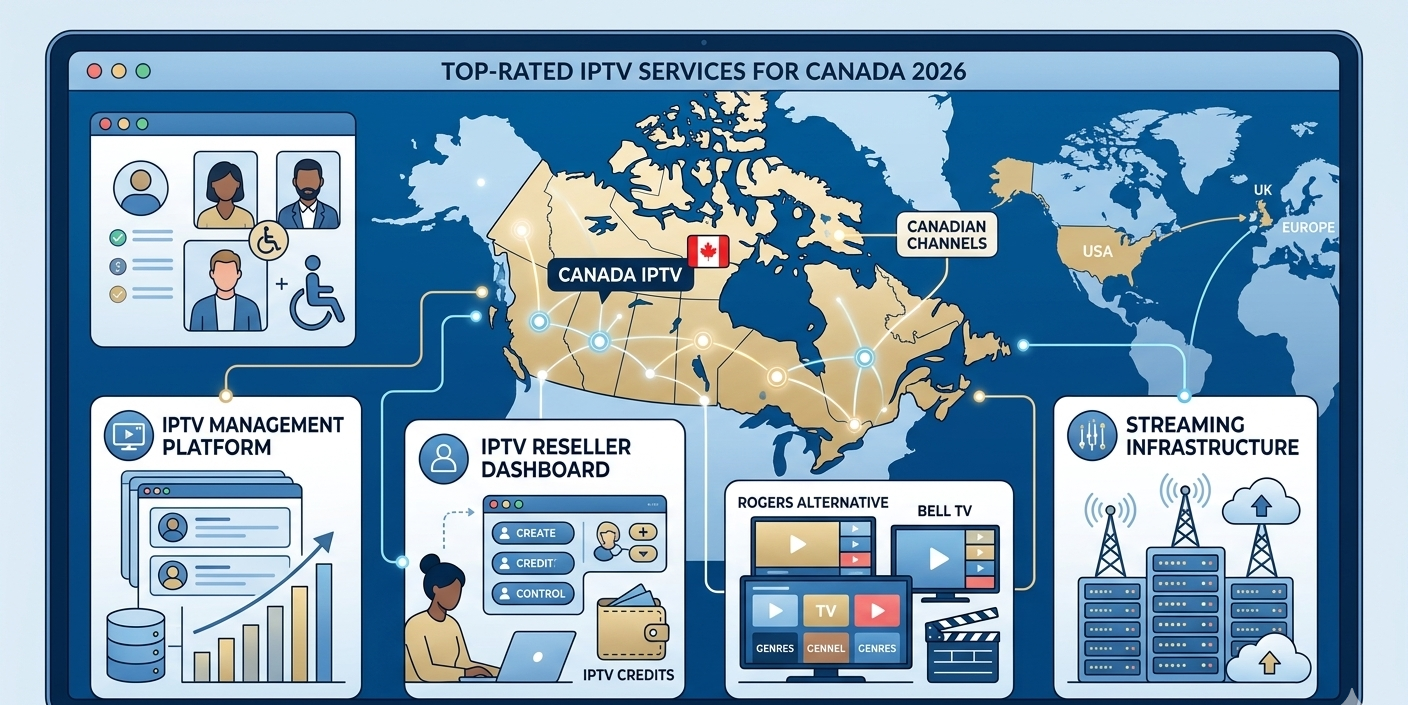
The two broadcasters that come up in virtually every Canadian IPTV conversation are Rogers and Bell. Both operate cable and satellite TV services with significant market share. Both are expensive, Bell Fibe TV and Rogers Ignite TV regularly run CAD $100 to 150/month for sports-inclusive packages. The savings potential from switching to a well-configured IPTV setup is substantial, but only if the Canadian-specific channels are actually covered.
This guide focuses on what Canadian coverage actually looks like, how to verify it before committing, and how the management infrastructure behind the service works.
What Canadian Viewers Actually Need
Before evaluating any IPTV service for Canadian subscribers, check these specific requirements.
Sports is the primary driver of demand, including TSN (The Sports Network), the Canadian sports broadcaster that holds NHL, CFL, and major international sports rights, Sportsnet, the Rogers-owned sports network holding significant NHL rights, CBC Sports for public broadcaster sports coverage, and RDS and TVA Sports for French Canadian sports viewers.
French Canadian content is a significant market, covering TVA and TVA Sports, RDS (Réseau des sports), Canal Vie, Canal D, Série+, and Radio-Canada (the French CBC equivalent).
English Canadian broadcast networks matter too: CBC (Canadian Broadcasting Corporation), CTV, Global, City TV, and APTN (Aboriginal Peoples Television Network).
Regional content also counts. Canadians care about regional news and local channels in a way that often surprises UK IPTV reseller from other markets. A Montreal client wants Montréal local news. A Vancouver client wants BC-specific content. Generic “Canadian” packages frequently skip regional channels entirely.

IPTV channel list showing Canadian channels organised by language with TSN, Sportsnet, and CBC highlighted
Verifying Canadian Coverage Before Selling It
The gap between “we have Canadian channels” and “our Canadian coverage actually works reliably during an NHL playoff game” is enormous. Here’s how to verify.
Test during a live NHL or CFL game first. Canadian sports streams get hammered during peak events. A provider that streams TSN cleanly on a Tuesday afternoon may struggle during a Game 7. If you’re planning to serve Canadian sports fans, test during actual game times, Saturday afternoon NHL double-headers are a reasonable simulation.
Check the French/English balance next. If you have Quebec-based clients or any French Canadian subscribers, verify RDS and TVA specifically. Many providers have strong English Canadian channel coverage with token French coverage that doesn’t actually work.
Test regional news channels too. Load a couple of regional news channels (CTV BC News, CTV Toronto, Global Montreal) and verify they’re broadcasting correctly and that EPG times match local time zones.
Finally, verify time zones are handled correctly. Canada spans six time zones (NST, AST, EST, CST, MST, PST). An NHL game starting at 7pm ET shows at 4pm PT. EPG data needs to be calibrated to the subscriber’s location, not a generic “Canada” time zone. If a client in Vancouver sees games listed at the wrong time, that’s a configuration problem worth fixing before it becomes a support call.
Setting Up Canadian Client Accounts in the Dashboard
The account setup process for Canadian clients has a few specifics worth noting.
Step one is logging into the dashboard. Navigate to the User Management tab. Standard login. The panel sometimes takes slightly longer to load on a slower connection, not unusual, just worth knowing if your first session seems sluggish.
Step two is selecting the right package. If your upstream provider offers a dedicated Canadian package, use it. The channel selection and EPG data are almost always better calibrated than a generic North American package. If they only offer North American, specifically verify that TSN and Sportsnet are included and working before proceeding.
Step three is setting the time zone for the client’s province. Configure the account’s time zone settings to match where in Canada your client is located. Eastern Canada (Ontario, Quebec, Maritimes) is ET. Western Canada (BC, Alberta) is PT or MT. This takes about 30 seconds in the account settings and prevents a whole category of EPG-related complaints.
Step four is configuring concurrent connections. Canadian households that subscribe to cable TV are used to watching on multiple devices. Rogers and Bell both offer multi-screen packages. Match that expectation, most Canadian clients benefit from a 2 to 3 connection account. Single connections generate more “it stopped working” support calls when someone picks up their phone to check a score while the TV is still playing.
Step five is confirming French or bilingual preference. For Quebec clients, confirm the package includes French channels and that those channels have French EPG data. Some packages have French channels listed but carry English EPG descriptions, which confuses French-speaking clients.
![Account creation form showing Canadian package selection with province-based time zone dropdown and connection limit settings]](https://martcarto.shop/wp-content/uploads/2026/03/Gemini_Generated_Image_3111933111933111-1024x493.png)
Here’s the full account creation workflow laid out step by step:
| Step | Action | Where | Notes for Canadian clients |
|---|---|---|---|
| 1 | Log into panel | Main login | Standard |
| 2 | Open User Manager | User Management tab | Existing or new client |
| 3 | Create account | Add New User button | Easy to remember username |
| 4 | Select Canadian package | Plan dropdown | Verify TSN/Sportsnet included |
| 5 | Set province time zone | Account settings | Critical for EPG accuracy |
| 6 | Set connection limit | Subscription Settings | 2-3 for household use |
| 7 | Configure French/English | Package preferences | Quebec clients especially |
| 8 | Deduct credits | Credit system | Standard |
| 9 | Generate credentials | Cloud system | M3U URL + Xtream codes |
| 10 | Deliver with setup guide | Encrypted message | Province-specific if possible |
Canadian Subscribers in the UK, USA, and Europe
A significant segment of the Canadian IPTV market isn’t in Canada at all, it’s Canadian expats abroad. There are substantial Canadian communities in the UK, Australia, and across Europe.
These subscribers have the same content requirements as Canadian residents, with the added challenge of time zone differences and geo-blocking on official Canadian streaming services. An expat in London wanting to watch NHL hockey faces the same blackout issues as an Australian expat wanting to watch AFL.
Timing matters a lot for expat clients. NHL evening games in Eastern time start at midnight to 1am UK time. Hockey Night in Canada runs late Saturday evenings Eastern time, meaning very late UK nights. CFL games on Sunday afternoons Eastern time are Sunday evening UK time, more manageable.
For expat clients, catch-up functionality on Canadian sports channels is particularly valuable since they’ll frequently miss live broadcasts. Verify whether your provider’s Canadian package includes catch-up for sports, not just live access.
Real Setup Mistakes Made With Canadian Clients
One mistake was not checking TSN vs. TSN Regional. TSN operates regional feeds, TSN1 through TSN5 carry different content depending on the region. A client in Alberta asking why they couldn’t see a specific game was because the game was on TSN2 West, which the provider had listed as TSN2 but was actually running the East feed. It took three conversations to identify the issue. Now it’s worth asking clients which province they’re located in during onboarding.
Another mistake was assuming EST was correct for all Canadian clients. A client’s account was set up with Eastern time zone without asking where they were. They were in British Columbia. Every NHL broadcast was showing 3 hours early in the EPG. They thought the guide was broken, it was just the wrong time zone. Now time zone is one of the first things to confirm during Canadian client onboarding.
A third mistake was not verifying French content for a Quebec client. A client from Montreal specifically mentioned they wanted French channels. The package was confirmed to have “French Canadian content” with the provider, but the channels were present while the sound was English. Several channels labelled as French were actually dubbed versions with incorrect audio tracks, requiring a switch to a different provider with proper French Canadian streams.
A fourth mistake was selling Canadian sports packages before verifying playoff performance. Three Canadian hockey clients were signed up in early spring. Regular season NHL streams worked fine. When the playoffs started in April, TSN and Sportsnet streams had consistent buffering during peak playoff viewing. The provider’s infrastructure couldn’t handle the load increase, requiring a mid-playoff migration for all three clients, not a good client experience. Now it’s worth load-testing during a busy playoff evening before taking on new Canadian sports clients.
A fifth mistake was not offering bilingual setup instructions. The setup guide was English-only. A French-speaking Quebec client couldn’t follow it and set up their app incorrectly. The stream worked but the EPG was misconfigured and catch-up wasn’t enabled. They used the service with degraded functionality for two weeks before reaching out. Now a French version of the core setup guide is available.
What Most Canadian IPTV Guides Get Wrong
Rogers/Bell alternatives aren’t about channel count, they’re about sports. A Canadian client replacing Bell Fibe primarily wants TSN and Sportsnet. Everything else is secondary. If those two channels work well during NHL games, you have a satisfied client. If they don’t, no amount of additional channel depth compensates.
The Quebec market needs separate handling. French Canadian viewers aren’t served by English Canadian channel packages with a few bonus French channels. They need RDS, TVA Sports, and the French-language entertainment channels to actually work correctly. This is a distinct service offering that requires a provider with genuine French Canadian coverage, not a provider that checks a box.
Canadian time zones are complicated and matter a lot for sports. NHL schedule announces game times in Eastern time. Subscribers in other time zones need EPG data showing their local start time. Getting this wrong generates consistent, frustrating support calls that could have been prevented with 30 seconds of configuration.
NHL blackout rules still affect what’s shown. The NHL maintains complex blackout rules for certain games based on geographic market protection. Some providers navigate this better than others. A Canadian client may find specific games blacked out on one stream but available on another. This is worth knowing upfront so you can manage client expectations rather than troubleshoot after the complaint arrives.
Here’s how a basic panel compares to an advanced one for managing this market:
| Feature | Basic panel | Advanced panel |
|---|---|---|
| Time zone configuration per account | No | Yes |
| French/English language package splitting | Limited | Full |
| Canadian region-specific channel grouping | No | Yes |
| Real-time connection monitoring | No | Yes |
| Automated renewal reminders (bilingual) | No | Yes |
| White label branding | No | Yes |
| Sub-reseller management | No | Yes |
| API integration for automated billing | No | Yes |
And here’s how the reseller model stacks up against building your own infrastructure:
| Reseller model | Own server infrastructure | |
|---|---|---|
| Canadian content licensing | Provider-managed | Complex independent requirement |
| Time to market | Days | Months |
| Startup cost | Low (credits) | Very high (servers + licensing) |
| CRTC compliance considerations | Provider-managed | Your responsibility |
| Scalability | Immediate | Requires capacity planning |
| Technical overhead | Low | 24/7 responsibility |
The Canadian regulatory environment adds a layer of complexity to the own-infrastructure route that doesn’t apply in the same way to US operations. The CRTC (Canadian Radio-television and Telecommunications Commission) oversees broadcast distribution in Canada. For most operators, the UK IPTV reseller model’s infrastructure abstraction is more than a cost consideration, it’s also a regulatory one.
Who This Setup Is NOT Right For
Resellers without verified Canadian sports coverage should hold off. A generic North American package that hasn’t been specifically tested for TSN and Sportsnet during NHL game times is not ready for Canadian clients. Don’t take on Canadian subscribers until you’ve done that verification.
Operators not ready for bilingual support face challenges too. The Quebec market is substantial and French-speaking. If you can’t provide setup guidance and basic support in French, either develop that capability before targeting Quebec clients or don’t target that segment.
Resellers using price-first provider selection will struggle here. The Canadian sports market is unforgiving of stream quality issues. Clients paying CAD $20 to 30/month for an IPTV alternative to a CAD $130/month cable package expect the service to work during the playoffs. Budget providers that can’t handle peak sports load generate churn and reputational damage fast.
FAQ
What’s the minimum a Canadian IPTV package needs to include to be worth it?
TSN and Sportsnet are non-negotiable for Canadian sports fans. CBC and CTV for general viewing. For Quebec clients, RDS and TVA Sports replace or complement TSN/Sportsnet. Everything else is a bonus. A package with excellent coverage of those core channels and reliable stream quality during NHL games will satisfy the vast majority of Canadian subscribers.
How does NHL blackout affect IPTV for Canadian subscribers?
NHL applies geographic blackout rules to protect local market broadcasters. This means some games might be blacked out on certain stream sources depending on which regional feed your provider uses. This is a provider-level issue, not something you can configure from the IPTV reseller dashboard. Ask your upstream provider specifically how they handle NHL blackout rules before marketing heavily to hockey fans.
Do I need separate packages for English and French Canadian clients?
Ideally yes, or at minimum a single package with both strong English and French channel coverage. The more practical approach for most resellers is to verify that your standard Canadian package has genuine French channel coverage before taking Quebec clients, rather than maintaining separate packages. Test RDS and TVA Sports specifically, these are the channels that reveal French Canadian coverage quality.
What time zones do I need to support for Canadian clients?
Six: NST (Newfoundland, UTC-3:30), AST (Maritimes, UTC-4), EST (Ontario and Quebec, UTC-5), CST (Manitoba, UTC-6), MST (Alberta and Saskatchewan, UTC-7), and PST (BC, UTC-8). Note that Saskatchewan doesn’t observe daylight saving time, creating seasonal discrepancies with Alberta. For practical purposes, ask clients which province they’re in and configure accordingly.
Can I serve Canadian clients from outside Canada?
Yes. The service is internet-based and operates regardless of where you’re located as a IPTV Panel reseller. The practical consideration is support hours, if your Canadian clients watch hockey in the evening Eastern time and you’re in the UK, those support requests arrive between midnight and 3am your time. Clear expectations and good self-help materials reduce this friction.
What’s the realistic savings for a Canadian switching from Rogers or Bell?
Rogers Ignite TV and Bell Fibe TV with sports packages typically run CAD $120 to 150/month. A well-configured IPTV alternative runs CAD $20 to 35/month. The saving is CAD $85 to 130/month, or roughly CAD $1,000 to 1,500 annually. This is a genuine financial motivation that makes Canadian clients receptive to switching, provided the service quality is there.
How do I handle a client who specifically asks about Rogers channels versus Bell channels?
Both Rogers and Bell operate cable networks that broadcast the same major channels (TSN, Sportsnet, CBC, etc.) through different infrastructure. The IPTV equivalent doesn’t map to Rogers vs. Bell, it maps to whether the channels those services carry are present and working. When clients ask about “Rogers alternatives” they typically mean they want the same channel lineup they had with Rogers. Confirm your package has TSN, Sportsnet, and their regional channels, and you’ve addressed the underlying requirement.
The Canadian market rewards preparation more than most. The combination of strong sports culture, significant French-speaking population, complex time zones, and high cable prices creates real demand, but that demand comes with high expectations about content quality and reliability.
Serve it well and Canadian clients tend to be loyal. Serve it poorly and they’re the first to share their experience with other expats or in community forums.
Verify coverage before selling. Configure time zones correctly from day one. Know which channels matter most. That covers the vast majority of what separates successful Canadian IPTV operations from struggling ones.