
“Is IPTV legal?” gets asked constantly, and the honest answer is: it depends entirely on what’s being streamed and whether the provider has the rights to distribute it.
The technology itself, internet-based TV delivery using M3U playlists, Xtream codes, and subscription management software, is completely legal. What creates legal complexity is the content layer: who holds the broadcast rights, in which territories, and whether the service distributing that content has licensed those rights.
A streaming subscription management platform operates at the software and administrative layer, not the content layer. Understanding that distinction is foundational to understanding how the legal framework applies to different participants in the IPTV ecosystem.
What’s Actually Legal vs. What Isn’t
The legal landscape breaks down clearly when you separate the components:
Definitively legal:
Subscription management software and IPTV reseller panel
M3U playlist technology and Xtream codes API
Streaming hardware (Fire Sticks, Android boxes, smart TVs)
IPTV apps (TiviMate, IPTV Smarters Pro, etc.)
Distributing access to licensed content under proper broadcast agreements
Legally complex or potentially problematic:
Distributing access to content without the rights holder’s permission
Retransmitting premium channels (Sky, BT Sport, ESPN, etc.) without a sublicensing agreement
Operating in regions where the content isn’t licensed for distribution
The practical line: Subscription management platforms, reseller dashboards, and the administrative infrastructure around IPTV are legal tools. The legal question applies to what content flows through them and whether the upstream provider has proper licensing arrangements. That chain runs from the broadcaster to the licensed provider, through the reseller dashboard, to the end user, and the legal weight sits at the licensing step, not at the dashboard itself.
How Copyright Law Applies to IPTV
Copyright law, including the DMCA in the US and equivalent legislation in the UK (Copyright, Designs and Patents Act 1988) and EU, protects the creators and rights holders of television content.
When a broadcaster produces or licenses a sports event, film, or TV series, they hold distribution rights. Those rights specify who can transmit the content, in which territories, and on which platforms. Sky Sports holds UK rights to Premier League matches, for example. ESPN holds US rights to specific leagues. These are not the same rights, and they’re not transferable without explicit licensing agreements.
An IPTV provider distributing these channels without the rights holder’s permission is infringing those rights. This is the core legal issue in the IPTV space, not the technology, not the subscription model, not the software, but whether the content being streamed has been licensed for that distribution.
DMCA and its equivalent mechanisms work like this:
A rights holder identifies their content being distributed without authorisation. They send a takedown notice to the hosting infrastructure. The hosting provider is required to respond and remove the content. Persistent infringement can lead to further legal action.
For resellers operating the subscription management layer, the practical implication is: the content decisions made by your upstream provider determine your exposure. This is why due diligence on provider selection matters legally, not just operationally.
The Reseller’s Legal Position: What You’re Actually Responsible For
This is where most guides get vague. Let’s be specific.
A reseller operating through a subscription management platform is providing: account creation, subscription management, client support, and access to a service. What they’re typically NOT doing: hosting content, encoding streams, distributing broadcast signals, or making content decisions.
The legal responsibility question is whether a reseller is knowingly facilitating access to unlicensed content. This is where the “we only provide software tools” statement isn’t just marketing language, it’s a genuine legal distinction that matters in most jurisdictions.
The practical guidance for resellers who want to operate on solid legal ground:
Ask your upstream provider directly whether they have licensing agreements for the channels they distribute. A legitimate licensed provider will be able to describe their content agreements. A provider that deflects or refuses to address this question is a red flag.
Understand that “everyone does it” is not a legal defence. The widespread nature of unlicensed IPTV distribution doesn’t change its legal status. Enforcement activity has been increasing in the UK and EU, targeting both large-scale operators and, increasingly, individual resellers.
Keep clear records of what you’re providing. Documentation showing you operate subscription management software and direct clients to an upstream provider, rather than hosting or distributing content yourself, establishes your operational position clearly.
Regional Differences: UK, USA, and EU
The legal framework varies by jurisdiction in ways that matter practically.
United Kingdom: The UK has been among the most active in enforcement against unlicensed IPTV distribution. FACT (Federation Against Copyright Theft) and rights holders including Sky and the Premier League have pursued both large-scale operators and individual distributors. The Digital Economy Act 2017 increased penalties for online copyright infringement. UK-based resellers should be particularly attentive to provider licensing due diligence.
United States: The DMCA provides the main framework. Enforcement has been active at the platform level, ISPs receiving and acting on DMCA notices, hosting infrastructure takedowns, and civil litigation against larger operators. The “safe harbour” provisions that protect certain intermediaries require meeting specific conditions, including responding to takedown notices and not having financial benefit from infringement with the ability to control it.
European Union: The EU Copyright Directive (implemented across member states) and the 2019 Copyright Directive (Article 17 specifically) impose stronger obligations on platforms that host user content. The EU market has seen coordinated enforcement actions across multiple member states. GDPR compliance is an additional requirement for handling subscriber data, regardless of content licensing questions.
Practical takeaway: The legal trend in all three major markets is toward stricter enforcement and broader liability for the distribution chain, not just the original infringer. Operating with clear documentation of your role and proper due diligence on providers is increasingly important.
What “Licensed Streaming” Actually Means
The term gets used loosely. Here’s what genuine licensing looks like:
A legally licensed streaming service has agreements with rights holders that specify: what content they can stream, in which territories, on which platforms, and under what conditions. These agreements are negotiated and paid for. They’re the reason Netflix pays billions for content rights, and why licensed sports streaming services pay per-event fees for live broadcast rights.
A few indicators that an IPTV provider may have legitimate licensing:
- They can name the rights agreements they operate under
- Their content library is selective rather than trying to include everything
- Their pricing reflects the cost of legitimate licensing (which is not £5/month)
- They operate transparently with identifiable business information
- They focus on specific content categories where licensing deals are more accessible
An indicator of concern: a provider offering thousands of premium channels from multiple broadcasters at very low price points, with no information about how they’ve secured those rights. The economics of legitimate licensing simply don’t support that pricing model.
From the Dashboard: What Transparency Looks Like in Practice
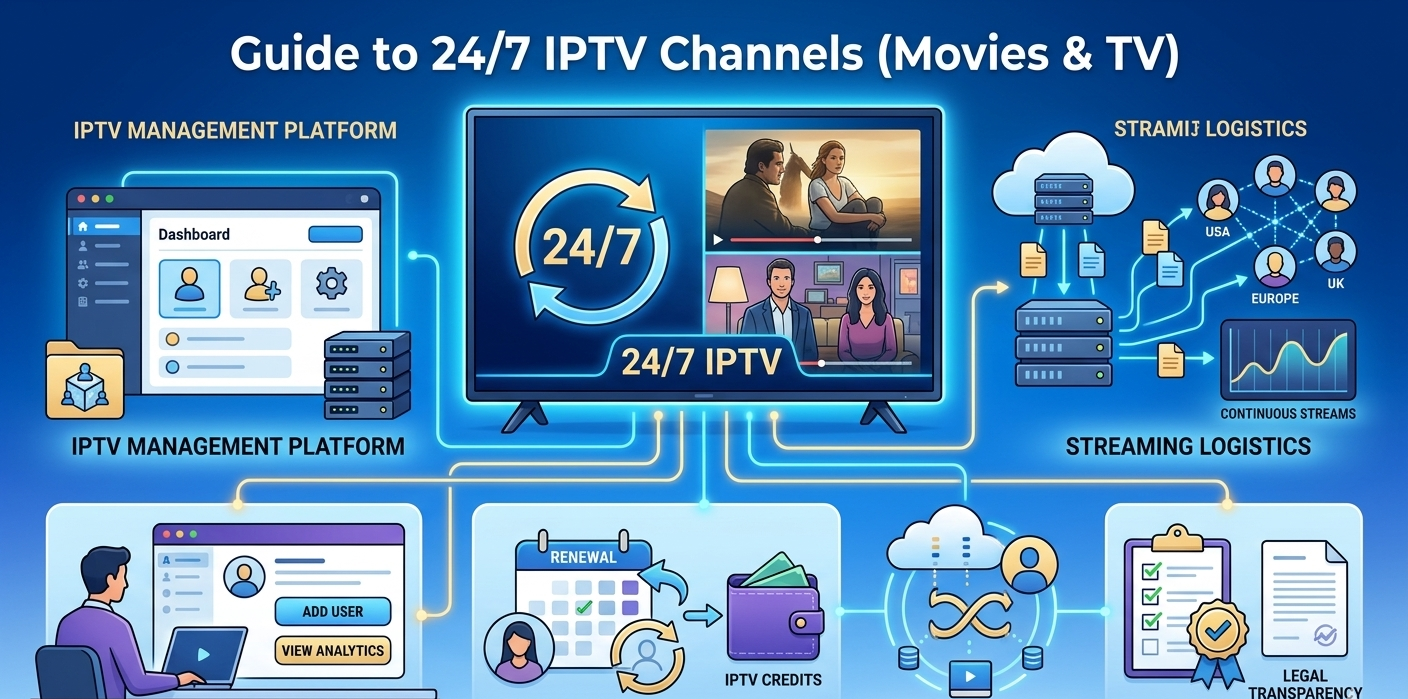
When I open the reseller dashboard, the operational clarity is visible immediately. The User Management tab shows subscriber accounts and their subscription status, the platform tracks access rights, not content. There’s no content hosted, no streams originating from the dashboard itself.
The Credit Management section shows credit purchases and account activation costs. The Subscription Settings for each account show plan duration and connection limits. The Activity Log records account creation, modifications, and support actions.
All of this is subscription administration. The infrastructure operates at the access management layer, what the platform does is manage who has access and for how long, not what content those accounts can reach. That content decision is made upstream.
This operational separation is why understanding the full service chain matters, dashboard operator, reseller, upstream provider, and content rights holder are distinct roles with distinct responsibilities.
Account Creation Workflow
| Step | Action | Where | Legal relevance |
|---|---|---|---|
| 1 | Log into panel | Main login | Reseller identity established |
| 2 | Open User Manager | User Management tab | Client management only |
| 3 | Create account | Add New User form | Subscription access created |
| 4 | Select plan | Plan dropdown | Duration defined |
| 5 | Deduct credits | Credit system | Business transaction recorded |
| 6 | Generate credentials | Cloud system | Access credentials issued |
| 7 | Deliver to client | Encrypted message | Client receives subscription |
The entire workflow operates at the administrative layer, account creation, access management, subscription tracking. No content is hosted, produced, or distributed through this process.
Real Situations I’ve Encountered Around Legality
Situation 1: A provider I used changed their channel lineup significantly
An upstream provider I’d been working with for several months significantly expanded their premium sports channel count, seemingly overnight. No announcement, no explanation of how they’d added major league sports rights so quickly. I asked them directly about the licensing basis for the new channels. Their response was evasive, references to “arrangements” without specifics.
That’s the kind of non-answer that warrants action. I migrated clients to a different provider and ended the relationship. The business risk of continuing with an operator who can’t or won’t explain their licensing position isn’t worth it.
Situation 2: A client asked if what they were doing was legal
A client asked directly whether their IPTV subscription was legal. I explained what I know to be true: the subscription management software and reseller platform operate legally; the content licensing question depends on the upstream provider’s agreements and is outside what I can verify with certainty. I recommended they review their local regulations and make their own assessment.
Being transparent about what you do and don’t control is the honest and appropriate response. Claiming certainty about the content licensing layer when you’re operating at the administrative layer isn’t accurate.
Situation 3: Navigating a DMCA inquiry
A hosting provider I use for a website received a DMCA notice related to IPTV content. This came from confusion about what the website did versus what a separate IPTV service did. Responding clearly and specifically, explaining the operational separation and providing documentation of what the site actually hosted, resolved it without escalation.
Clear operational documentation isn’t just good practice. It’s necessary when legal questions arise.
What Most IPTV Legal Guides Don’t Tell You
Enforcement is increasing, not decreasing. The narrative that unlicensed IPTV is too widespread to enforce is increasingly false. Rights holders have invested significantly in enforcement capabilities. Server takedowns, domain seizures, and prosecutions of distributors have all increased year-over-year in the UK and EU. This trajectory is continuing.
Resellers are increasingly being targeted, not just providers. Early enforcement focused on the infrastructure operators. The focus has been expanding to include the distribution chain, including resellers who knowingly facilitate access to unlicensed content. “I only sold subscriptions” is becoming a less reliable shield as enforcement becomes more sophisticated.
Terms of service are not the same as licensing. Some providers claim legitimacy by referencing terms of service or content policies. These are not the same as broadcast licensing agreements. A terms of service document doesn’t grant content rights.
Geo-blocking circumvention adds complexity. Many IPTV services make content available in territories where the rights holder hasn’t licensed it for distribution. This isn’t just a content licensing issue, it’s an additional layer of potential legal exposure for the operator and the distribution chain.
Who This Legal Complexity Doesn’t Apply To
Being specific about this:
Users accessing services for personal, non-commercial use face significantly lower legal risk than commercial operators. Rights enforcement has primarily targeted distributors and IPTV resellers, not individual subscribers. This doesn’t mean there’s zero risk, but the enforcement focus is on the commercial chain.
Operators using demonstrably licensed services, those with verifiable content licensing agreements, operate in a straightforward legal position. The complexity comes from the widespread use of unlicensed content, not from the technology or business model itself.
Software and platform providers who operate strictly at the administrative layer, providing subscription management tools without controlling content decisions, have a defensible legal position, provided they maintain operational separation from content decisions and respond appropriately to legitimate legal notices.
Feature Comparison: Basic vs. Advanced Panel for Compliance
| Feature | Basic panel | Advanced panel |
|---|---|---|
| Activity logging | Basic | Full audit trail |
| GDPR data management tools | No | Yes |
| Data deletion on request | Manual | Automated |
| Compliance documentation export | No | Yes |
| IP access restrictions | No | Yes |
| Encryption standards | Standard | Enhanced |
| Legal notice response tools | No | Yes |
FAQ
Is running an IPTV reseller business legal?
The subscription management software and reseller platform infrastructure are legal tools. The legal question applies to the content your upstream provider distributes, specifically whether they hold proper licensing for the channels they offer. Operating as a reseller using professional management software, with due diligence applied to provider selection, places you at the administrative layer of the service chain. Consult a solicitor in your jurisdiction if you need specific legal advice for your situation.
What is the DMCA and does it apply to UK resellers?
The DMCA (Digital Millennium Copyright Act) is US law. The equivalent UK framework is primarily the Copyright, Designs and Patents Act 1988, updated by the Digital Economy Act 2017. Both establish takedown mechanisms for infringing content and create obligations for platforms that host user content. UK IPTV resellers operating at the subscription management layer aren’t typically directly subject to DMCA, but the equivalent UK provisions apply.
How do I know if my upstream provider is licensed?
Ask them directly. A legitimate licensed provider can describe their content agreements specifically. Questions to ask: “What content licensing agreements do you operate under?”, “Are your premium sports channels licensed for distribution?”, “In which territories are you licensed to operate?” Evasive or generic responses to these questions are a warning sign.
Can I be held responsible for what my upstream provider streams?
This depends on jurisdiction, your operational role, and whether you knowingly facilitated access to infringing content. Maintaining clear operational separation (subscription management software, not content distribution), keeping records of your operational role, and conducting due diligence on provider licensing reduces legal exposure. This is not legal advice, consult a solicitor if you need guidance specific to your circumstances.
What should I do if I receive a copyright notice related to my IPTV operation?
Take it seriously. Do not ignore it. Document your operational role clearly, what your platform does and doesn’t do. Respond specifically and accurately to what the notice claims. If the notice is about content you don’t host or control, respond explaining the operational separation clearly. Seek legal advice if the notice is from a rights holder or their legal representative. Acting promptly and in good faith is important.
Does GDPR apply to IPTV resellers in the UK and EU?
Yes. If you hold personal data about subscribers, email addresses, usernames, payment records, GDPR (UK GDPR post-Brexit, EU GDPR for EU-based operations or EU customers) applies to how you collect, store, and process that data. Key requirements: collect only what you need, store it securely, be able to delete it on request, and have a legal basis for processing. The advanced UK IPTV reseller panel features that support data management and deletion are relevant here.
Is the legal situation improving or getting worse for IPTV resellers?
The enforcement trend is toward stricter application of copyright law and broader pursuit of the distribution chain. The legal situation for operators distributing unlicensed content is becoming more difficult over time, not less. For operators providing licensed services or operating strictly at the administrative software layer, the legal position is straightforward and stable.
IPTV legality isn’t a simple yes/no question, but it’s not infinitely complex either. The technology is legal. The software tools are legal. The business model of reselling subscription management access is legal when operated properly.
The legal complexity lives in the content layer, specifically whether the upstream provider has proper broadcast rights for what they distribute. That’s the question that matters, and it’s the question that careful provider selection and operational due diligence addresses.
Operating with clear documentation of your role, proper due diligence on providers, GDPR-compliant data handling, and transparent communication with clients puts you on solid operational and legal ground. That’s the practical framework, regardless of jurisdiction.