
The IPTV market in 2026 has a low barrier to entry. Anyone can set up a basic UK IPTV reseller panel, create a website, and start taking payments within a few days. Most people who do this are legitimate operators. A meaningful minority are not.
The scams range from outright theft, take the money, deliver nothing, to subtler situations where a service works for a month or two before degrading or disappearing. The second type is more common and harder to spot in advance.
Understanding what separates legitimate operators from problematic ones isn’t complicated, but it requires knowing what to look for. Most people who get burned by a bad IPTV service didn’t see obvious red flags, they saw signals they didn’t know how to read.
Red Flag 1: No Trial Period Offered
Legitimate IPTV operators offer trials. A 24-48 hour trial at low or no cost is the industry standard for good reason, it lets a potential subscriber verify the service works on their device before committing money.
Providers who refuse trials or push back heavily when you ask for one are either confident their service won’t pass scrutiny, or they’re running a model that depends on collecting upfront payments before issues become apparent.
The appropriate response to “no trials, we’re confident in our quality” is to find a different provider. There’s no shortage of legitimate operators who offer trials without hesitation.
Red Flag 2: Unrealistic Claims About Channels, Quality, and Uptime
Legitimate providers are specific and measured about what they offer. Scam operations tend toward hyperbole: “100,000 channels,” “100% uptime guaranteed,” “4K on every channel,” “best service in the world.”
No IPTV provider has 100,000 functioning channels. No service achieves 100% uptime. Promises like these signal either ignorance or deliberate deception, neither is reassuring.
What legitimate providers look like in their claims: specific channel counts in a realistic range, honest acknowledgement that occasional server issues occur, clear information about what’s actually available in their package.
If the marketing language sounds like it was written to impress rather than inform, treat it with appropriate scepticism.
Red Flag 3: Only Anonymous Payment Methods Accepted
Payment method tells you a lot about accountability. A provider who only accepts cryptocurrency or untraceable payment methods has deliberately removed any financial recourse you’d have if things go wrong.
Legitimate operators accept PayPal Goods and Services (which has a dispute process), credit/debit cards (which have chargeback rights), or at minimum offer one method that provides buyer protection alongside crypto options.
This doesn’t mean crypto payment is inherently suspicious, many legitimate providers accept it. The problem is when it’s the only option. That’s a deliberate choice to eliminate accountability.
Red Flag 4: No Visible Business Information or Contact Method
Before paying any IPTV provider, ask yourself: if something goes wrong, how do I contact them?
Scam operations typically have no verifiable contact information, no email address that responds, no support ticket system, no WhatsApp or Telegram contact that actually answers. The website exists to collect payments, not to provide ongoing service.
Legitimate resellers are accessible. They have a working contact method and they respond to it. Before subscribing, test the contact method with a basic pre-sales question. How quickly they respond and how helpfully they answer tells you a great deal about what support will look like after you’ve paid.
Red Flag 5: Fake or Manipulated Reviews
Review manipulation in the IPTV space is common. Signs of manipulated reviews:
- Clusters of very similar, short, enthusiastically positive reviews posted within a short window
- No negative reviews whatsoever, not even minor complaints
- Reviewers with no profile history outside of this single service
- Reviews that use identical or near-identical phrasing
- No reviews on any platform other than the provider’s own website
Genuine review profiles look different: a spread of ratings including some 3-star and 4-star reviews alongside the positive ones, specific technical observations, mentions of problems alongside praise for how they were handled, reviewers with identifiable posting histories.
The most reliable reviews come from communities where the provider isn’t hosting the conversation, Reddit’s r/IPTV, AVForums, Digital Spy. Look there rather than trusting the testimonials section on the provider’s own site.
Red Flag 6: The Price Is Suspiciously Low
There’s a floor below which IPTV services can’t be profitable while maintaining real infrastructure. If a provider is offering 12-month subscriptions with “unlimited channels” for £5 or less, the economics don’t work for a legitimate operation.
This doesn’t mean you should overpay, there are good services at reasonable prices. It means that pricing significantly below market rate (£10-30/month for a legitimate service) is a signal worth investigating rather than celebrating.
Extremely cheap services typically achieve their pricing by:
- Running on unstable, overloaded infrastructure
- Disappearing after a few months once they’ve collected enough payments
- Using the service as a loss leader to collect payment information
Red Flag 7: No Professional Management Infrastructure
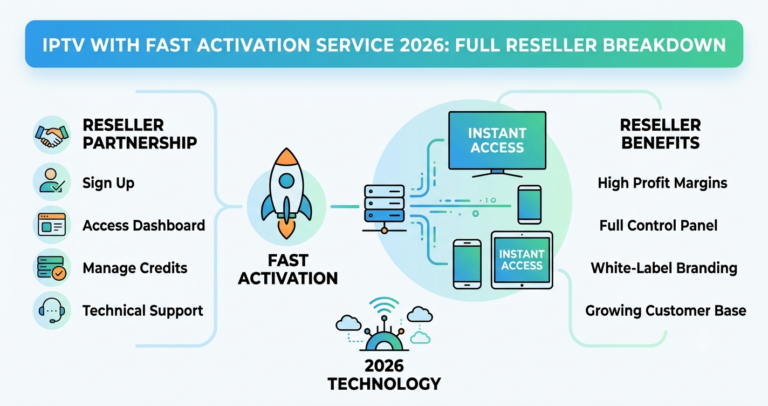
A legitimate IPTV reseller operates through a professional management panel, a dashboard that handles subscription management, account creation, and client support. When you contact a reseller with a question about your account, they should be able to answer it quickly because they have the tools to look it up immediately.
Resellers operating without professional infrastructure, managing accounts manually through spreadsheets or informal methods, can’t provide consistent service at any meaningful scale. They also tend to disappear when things get complicated.
The way to test this: ask pre-sales questions that require looking up account information. “Can you show me how account management works?” or “What happens if I need to change my plan mid-subscription?” A legitimate operator answers these confidently and specifically.
What Legitimate Operations Actually Look Like
Knowing what to avoid is helpful. Knowing what good looks like is more useful.
Signs of a legitimate IPTV reseller:
- Trial period offered without pressure
- Realistic, specific claims about channel count and service quality
- Clear contact method that actually responds
- Multiple payment options including at least one with buyer protection
- Reviews across third-party platforms with a realistic spread of ratings
- Pricing in the normal market range
- Specific answers to technical questions about the service
- Transparent explanation of what they are (a reseller providing subscription management software) versus what they aren’t (a content creator or broadcaster)
The last point matters. A legitimate operator is clear about their role. They provide access to a subscription management platform. They don’t make content claims they can’t back up.
How the Reseller Dashboard Enables Legitimate Operations
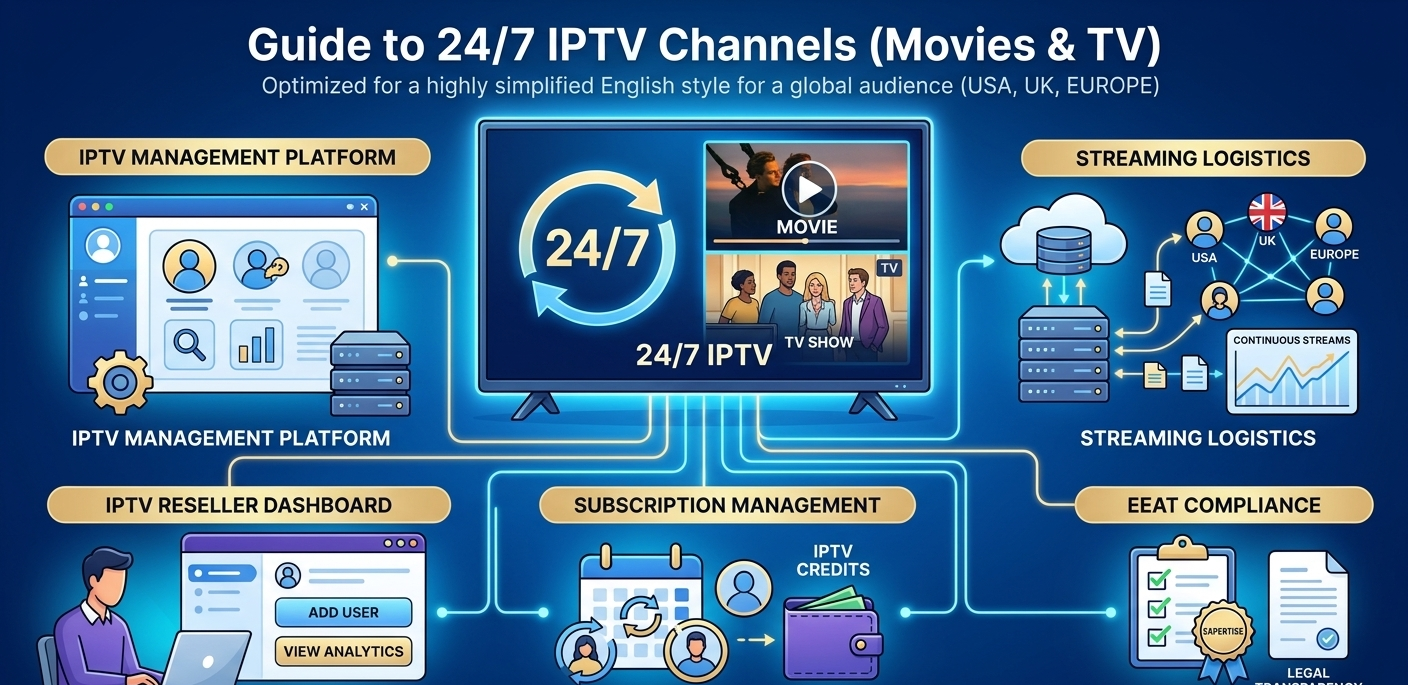
A professional reseller’s daily work happens inside a management dashboard. Understanding what this looks like helps distinguish legitimate operators from informal ones.
The User Management tab is the centre of operations, every active client account, their subscription status, expiry date, and connection activity is visible here. When a client reports an issue, the reseller can see within seconds whether the account is active, when it expires, and whether there are active connections.
The Credit Management section shows available credits for activating new accounts, purchase history, and upcoming credit requirements based on renewal dates. A well-run operation keeps a credit reserve to handle renewals without cash flow gaps.
Account creation takes about 2 minutes: User Management tab → Add New User → enter credentials → select plan → confirm credit deduction → generate M3U URL → deliver credentials. The whole process is auditable in the dashboard’s activity log.
This infrastructure, logging, account tracking, credit management, support access, is what enables legitimate operators to provide consistent service. Operators running without it are relying on manual processes that break down at scale and leave no accountability trail.
Account Creation Workflow
| Step | Action | Where | Result |
|---|---|---|---|
| 1 | Log into panel | Main dashboard | Full access confirmed |
| 2 | Open User Manager | User Management tab | Client list visible |
| 3 | Create account | Add New User form | Credentials form opens |
| 4 | Enter client details | Data fields | Username/password set |
| 5 | Select plan | Plan dropdown | Duration defined |
| 6 | Deduct credits | Credit system | Account activated |
| 7 | Generate stream URL | Cloud system | M3U URL created |
| 8 | Deliver to client | Encrypted message | Client sets up device |
Real Mistakes I’ve Made Trusting Wrong Providers
Mistake 1: Taking the cheapest option for a test
Found a provider offering 3 months for £8. Thought it would be useful to test a budget option. Worked fine for 3 weeks. Then constant buffering started. By week 6 the service was essentially unusable. The provider’s support contact had stopped responding. Had to migrate affected clients to a different service. The cheap test cost more in time and client relationship repair than any saving justified.
Mistake 2: Trusting a provider based on a single community recommendation
One post in a forum recommended a specific provider. Didn’t check the posting history of the account making the recommendation. Didn’t look for corroborating reviews elsewhere. Signed up and started recommending to clients. The provider turned out to be unreliable, strong performance for the first month, significant degradation after. The single recommendation was almost certainly a planted post. Now I cross-reference across at least three independent sources before onboarding a new provider.
Mistake 3: Not testing peak-time performance before committing
Evaluated a provider during a weekday morning, low server load, everything performed well. Recommended to clients without testing during a major sports weekend. The first Premier League Saturday, multiple clients reported streams dropping simultaneously. The provider’s infrastructure couldn’t handle peak demand. Always test on a high-demand weekend evening before declaring a provider reliable.
Mistake 4: Waiting too long to switch when problems started
A provider I’d been using for a year started showing reliability issues, intermittent server problems, slightly longer support response times. I stayed longer than I should have, partly out of inertia and partly hoping it would stabilise. It didn’t. The slow decline cost more in client trust than a swift provider change would have. When reliability problems become a consistent pattern, act on it rather than hoping for improvement.
What Most Scam-Warning Guides Don’t Tell You
Slow decline is more common than sudden disappearance. The dramatic “took the money and ran” scam exists but it’s less common than the gradual quality degradation, a service that works acceptably at launch, degrades over months as the operator cuts costs or their upstream provider changes, and eventually becomes unusable. Watch for slow decline as carefully as for sudden failures.
Some “scam” complaints are actually user error. Not every bad review represents a bad service. Users who configure apps incorrectly, use poor hardware, or have slow broadband sometimes blame the IPTV service for problems they’re causing themselves. Read negative reviews critically, complaints about “buffering” with no details about connection speed or hardware are less informative than complaints about specific, reproducible service failures.
The reseller relationship matters as much as the provider. Even if the upstream provider has excellent infrastructure, a poorly-run reseller creates problems, slow support, incorrect account setup, credential delivery issues. A great provider delivered through a bad reseller is still a bad experience. Evaluate the reseller’s operational quality alongside the underlying service.
Trial periods can be misleading. As mentioned in an earlier guide, providers sometimes provision trial accounts better than paid accounts. A clean trial doesn’t guarantee consistent paid service. A trial is a minimum bar, not a definitive test. Reviews from users who’ve been subscribed for 3+ months are more valuable than trial experiences.
Protecting Yourself as a Reseller
If you’re operating as a reseller rather than an end user, the risk landscape is different. You’re the accountable party for your clients, if your upstream provider fails, your clients hold you responsible.
Practical protection measures:
Don’t commit all clients to long plans with a new provider. Keep clients on monthly plans until you’ve verified a provider’s 3-6 month reliability. Annual plan commitments create financial exposure if the provider deteriorates.
Maintain a credit reserve. Running your credit balance to near-zero creates operational risk. A 20% buffer above expected monthly usage is a reasonable minimum.
Have a backup provider relationship. Identifying and maintaining a basic relationship with an alternative provider before you need one means you can migrate clients quickly if your primary provider has problems.
Document everything. Use your dashboard’s audit logs. Keep records of client accounts, payment history, and communications. If a dispute arises, documentation is what resolves it.
Feature Comparison: Basic vs. Advanced Panel for Security and Accountability
| Feature | Basic panel | Advanced panel |
|---|---|---|
| Full audit logging | No | Yes |
| Real-time connection monitoring | No | Yes |
| Suspicious activity alerts | No | Yes |
| Two-factor authentication | No | Yes |
| IP access restrictions | No | Yes |
| Client data encryption | Standard | Enhanced |
| Automated expiry notifications | No | Yes |
FAQ
How do I verify an IPTV reseller is legitimate before paying?
Test the contact method before subscribing, send a pre-sales question and see how they respond. Check for reviews on third-party platforms (Reddit r/IPTV, AVForums) rather than the provider’s website. Ask about their trial policy. Look for realistic claims rather than marketing hyperbole. A legitimate operator handles all of these without evasion.
What should I do if I’ve already paid and the service stops working?
Contact the reseller immediately. If they’re unresponsive within 24-48 hours, initiate a dispute through your payment method, chargeback for cards, dispute process for PayPal Goods and Services. Document everything: payment confirmation, when service stopped, your contact attempts. For crypto or bank transfer payments, you have limited recourse and negotiation with the provider directly is the only path.
Are cheap IPTV services always scams?
No, but they’re higher risk. Some legitimate operators price competitively, particularly in markets with many UK IPTV resellers competing on price. The issue is when pricing is significantly below what sustainable operations cost. Test before committing, keep plans short until reliability is established, and don’t assume low price equals good value.
How can I tell if a negative review is genuine or a competitor attack?
Competitor attack reviews tend to be vague and hyperbolic (“terrible service, don’t use, scam”). Genuine negative reviews tend to be specific, they describe what failed, when, and what the resolution attempt looked like. Genuine reviews also appear on multiple platforms rather than concentrated on one. A pattern of very similar vague negative reviews appearing in a short window suggests coordination rather than organic feedback.
What payment method gives me the best protection?
Credit card provides the strongest protection through chargeback rights (Section 75 in the UK for purchases over £100). PayPal Goods and Services provides a dispute process. These two options offer meaningful recourse if a service fails to deliver. Avoid providers who only accept crypto or bank transfer for new subscribers, both eliminate financial recourse.
Is it safe to use my main email address when signing up for IPTV?
Using a secondary email reduces exposure if a provider’s data handling is poor. Most legitimate IPTV resellers in UK and EU markets have GDPR obligations around data handling, but using a secondary address for IPTV subscriptions is reasonable privacy hygiene regardless. It also makes it easier to identify and filter subscription-related communications.
What’s the difference between a reseller scam and a provider going out of business?
Intent. A scam involves deliberately collecting payments with no intention of delivering sustained service. A legitimate provider going out of business is a business failure, unfortunate but not fraudulent. In practice, the outcome for the subscriber is similar, which is why short plans and protected payment methods matter regardless. The distinction becomes relevant if you’re considering pursuing recovery, fraud has different legal remedies than business failure.
The IPTV market has enough legitimate operators that there’s no need to take risks on unverified providers. The verification process, trial, contact test, review check, payment method assessment, takes 30-60 minutes and eliminates the vast majority of potential problems.
The people who get burned by bad services are almost always people who skipped part of this process. Moved too fast, trusted a single recommendation, took the cheapest option without testing. Those aren’t mistakes that happen to sophisticated, careful buyers. Take the time, follow the checks, and the IPTV experience is generally very positive.