
How I Run a Profitable IPTV Reseller Business: Lessons From Years on the Panels
People keep telling me reselling IPTV is easy money. They’re half right. The startup cost is almost nothing, the demand isn’t going anywhere, and once your setup is stable the renewals land in your account whether you’re working or asleep. I’ve seen it firsthand. But that’s only one side of the coin, and the other side is where most people quietly lose their shirt.
What’s also real is why most beginners fail. They fixate on price, undercut everyone, win a few customers, then watch those same customers vanish the first time a stream stutters during a big match. I’ve been on the operator side of this long enough to tell you plainly: the cheapest seller rarely wins. The reliable one does.
This is the blueprint I’d hand a partner starting out, broken into five pillars that actually decide whether your business lasts or flames out in ninety days.
Your Provider Is the Foundation, Everything Else Sits on Top of It
I learned this the hard way. Years ago I picked a panel because the credit price was the lowest I could find, and for about three weeks it was fine. Then a Saturday derby hit, the source server choked under the load, and I spent the night watching my WhatsApp fill up with angry messages I couldn’t answer. By Monday I’d lost a third of my clients. The server feeding your streams is the one thing you cannot patch over with good marketing or a friendly tone. If it stutters at peak hours, you’re finished, you just don’t know it yet.
When I evaluate a panel provider, I’m not reading their sales page, I’m asking pointed questions and testing the answers.
Ask how they handle load, and listen to how specific they get. Anyone can paste ‘99.9% uptime’ on a sales page. What I actually want to know is what happens to their edge servers on a Champions League night when half of Europe tunnels into the same channel inside a ten-minute window. A solid provider will talk to you about how they spread that traffic across nodes, how their failover kicks in, maybe even which CDN they lean on. A weak one changes the subject. That vagueness is the whole answer right there.
The channel list has to fit who you’re actually selling to, not just look big on paper. If your buyers are expat families, what matters is whether the home-country bouquets are deep and current, not whether there are four thousand channels nobody watches. If you’re selling to sports diehards, every league and every PPV event needs to run clean on the night it matters, because that’s the only night they’re judging you. Match the library to your crowd and you can charge more without anyone blinking.
Spend ten minutes inside the panel before you commit to anything. Creating a line, spinning up a trial, pushing a renewal, this is stuff you’ll do dozens of times a day once you’re rolling. If the dashboard lags or buries simple actions three clicks deep, that friction adds up into real hours every week, and it slows you down at the exact moment a customer is waiting on you to get them live.
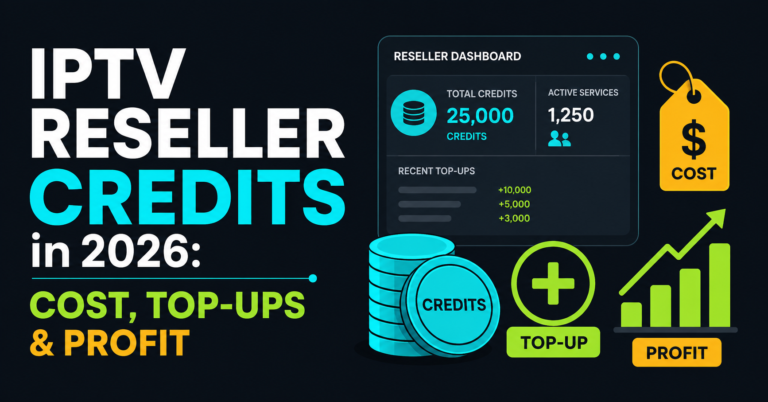
One thing nobody explains to beginners is how much flexibility lives in the credit system itself, if you understand it. A credit isn’t locked to a calendar month the second you buy it. I hold a small float of credits precisely so I can onboard a new client instantly at midnight without waiting on a top-up to clear, run a clean trial without burning a full subscription, or extend a loyal customer by a few days as a goodwill gesture that costs me almost nothing. Treat credits as working capital, not as one-credit-equals-one-month line items, and your onboarding gets noticeably smoother.
Support has to be reachable when things actually break, which is rarely during office hours. The real test is a server hiccup at 11pm on a Saturday. Do you get a human who fixes it, or a ticket number that sits unread until Monday morning while your clients fume? Find that out before you depend on them, not during your first outage.
A white-label option is what makes you look like a professional, standalone service instead of someone reselling another company’s product. Your own domain, branding, and logo build trust and let you set your own prices without customers comparing you to the source.
Pro-Tip from the Field:
Build an anti-fragile setup. Never run your whole operation off a single source. I keep what I call a redundancy panel, a fully provisioned backup provider sitting ready at all times. When my primary hit a regional outage last year, I migrated my VIP clients to the secondary in under ten minutes and framed it to them as scheduled maintenance. They never knew there was a problem. That one habit has saved more renewals than any discount I’ve ever run. A backup source feels like a waste of money right up until the night it quietly saves your whole client base.
Bottom line, pay more for stability. If your service works flawlessly, customers will happily pay for it.
The Free Trial Closes More Deals Than Any Pitch You Could Write
The free trial is the single most effective thing you can do to close a hesitant buyer. It proves your quality instantly and kills doubt. But a trial only converts if you work it actively, and most UK IPTV reseller just hand over a login and hope.
Here’s the three-step funnel I run on every demo.
Activate immediately. The moment someone requests a trial, I get them live within five minutes and send the login alongside dead-simple setup steps, usually pointing them at the Smarters app. Speed here signals that your support will be just as fast once they pay.
Follow up around the twenty-hour mark. Roughly four hours before the trial expires, I send one casual message: hope you’re enjoying it, everything working okay, let me know if you need a hand. It shows I’m paying attention, and it surfaces any technical snag while there’s still time to fix it before it becomes a reason to walk.
Close at trial end. Once it expires I send a direct payment link and a quick reminder of the benefits, something like: your demo has ended, secure your subscription now and keep watching without interruption. I never reactivate an expired trial. Extending it just teaches people they can stream for free if they stall.
The trial is really a test of two things at once, your stream quality and your support speed. Pass both and the sale is basically yours.
Build Your Plans So the Longer Commitment Is Obviously the Smart Buy
If monthly is the only plan you offer, you’ve signed up for maximum workload and maximum churn. Every thirty days you’re chasing renewals and absorbing processing fees. The fix is structuring your tiers so the longer commitments are clearly the better deal.
The way I structure it, each step up should feel like leaving money on the table if you don’t take it. Monthly sits at full price, and that’s deliberate, it’s the cautious first toe in the water for someone who isn’t sure about you yet. Quarterly is where I shave a little off, enough to steady my cash flow and cut my payment-processing count by two thirds for that client. The half-year tier gets a bit more off and is where habit starts to form, people stop thinking about whether to renew. The yearly plan is the one I actually want you on, and I frame the discount as three months free rather than a percentage, because ‘free’ lands harder than ‘twenty-five percent’ even when they’re the same number. A customer on annual is a year of locked revenue and almost no renewal chasing for me.
Lead with the annual plan in your advertising and make the savings the headline: save 25% with our one-year subscription, our best value. People anchor to that number even when they end up buying something shorter.
Operational Note:
A quiet word on payment friction. Payment processors keep getting stricter, and chargeback fraud is a genuine risk in this space. I offer a small extra discount, around 10%, for clients paying in USDT or Bitcoin. It wipes out chargeback exposure completely, and a fair few clients actually prefer it, since nothing tied to streaming ever shows up on their bank statement. Quiet little adjustment, but it protects you and reassures them at the same time.
Market Smart Without Sliding Into Spam
You need a steady flow of new customers, but the second you start blasting links into every group chat you can find, you’ve torched your reputation. The marketing that works here is targeted and helpful, not loud.
Your referral program is the strongest tool you’ve got. Happy customers sell better than any ad because their recommendation carries trust you can’t buy. I give existing users a free extra month for every new customer they bring in. It costs almost nothing and converts far better than cold outreach.
Targeted social ads work if you aim them precisely. Facebook and Instagram let you target by interest and location, so I’ll run ads pointed at fans of a specific league, or at expat communities looking for channels from home. Broad ads waste money fast; narrow ones pay for themselves.
Community help is the slow play that compounds. I join streaming and expat forums and just answer technical questions, no pitching at first. Over time you become the person people trust on this stuff, and when someone quietly asks for a recommendation, you’re the obvious answer. That credibility can’t be spammed into existence.
Be a Support Legend, Because Retention Is King
A customer who renews is worth far more than one you constantly have to replace, and retention comes down to two things: reliable IPTV streams and lightning-fast support. Here’s the standard I hold myself to.
Be accessible on the channels people actually use. WhatsApp, live chat, email, the more instant the better. When something breaks, customers want help now, not a callback tomorrow.
Move fast on tickets. I aim to respond inside five to ten minutes. A frozen stream turns a calm customer into a frustrated one quickly, and fast support is what stops frustration from hardening into a cancellation.
Stay proactive with information. If there’s scheduled maintenance, I message everyone before it happens. A surprise outage erodes trust; advance warning does the opposite and shows professionalism.
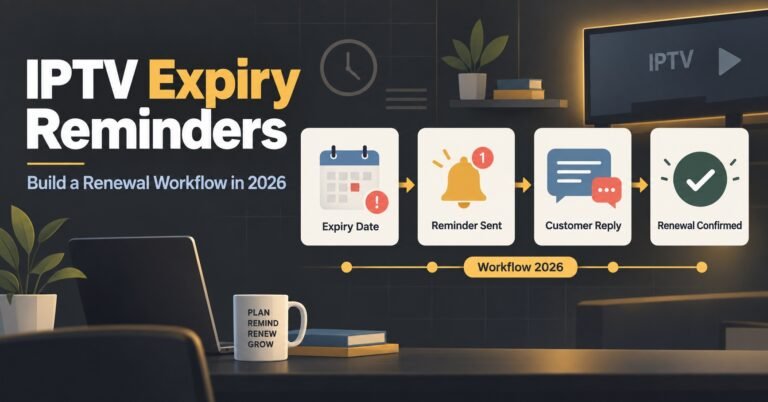
Make renewing effortless. I send an automated reminder three days before expiry with a one-click payment link. Zero friction, zero thinking required. The easier you make it, the more people just do it.
The real takeaway across all five pillars is this: you’re not selling content, you’re selling a reliable streaming experience and the confidence that someone competent is standing behind it. Commit to stability and speed, in both your streams and your support, and you’ll quietly outlast every competitor still racing to the bottom on price.
If you’re starting from scratch, don’t try to fix all five at once. Get a provider you genuinely trust nailed down first, because everything else you build sits on top of that one decision. The pricing, the marketing, the support polish, all of it can wait a week. A shaky source can’t.