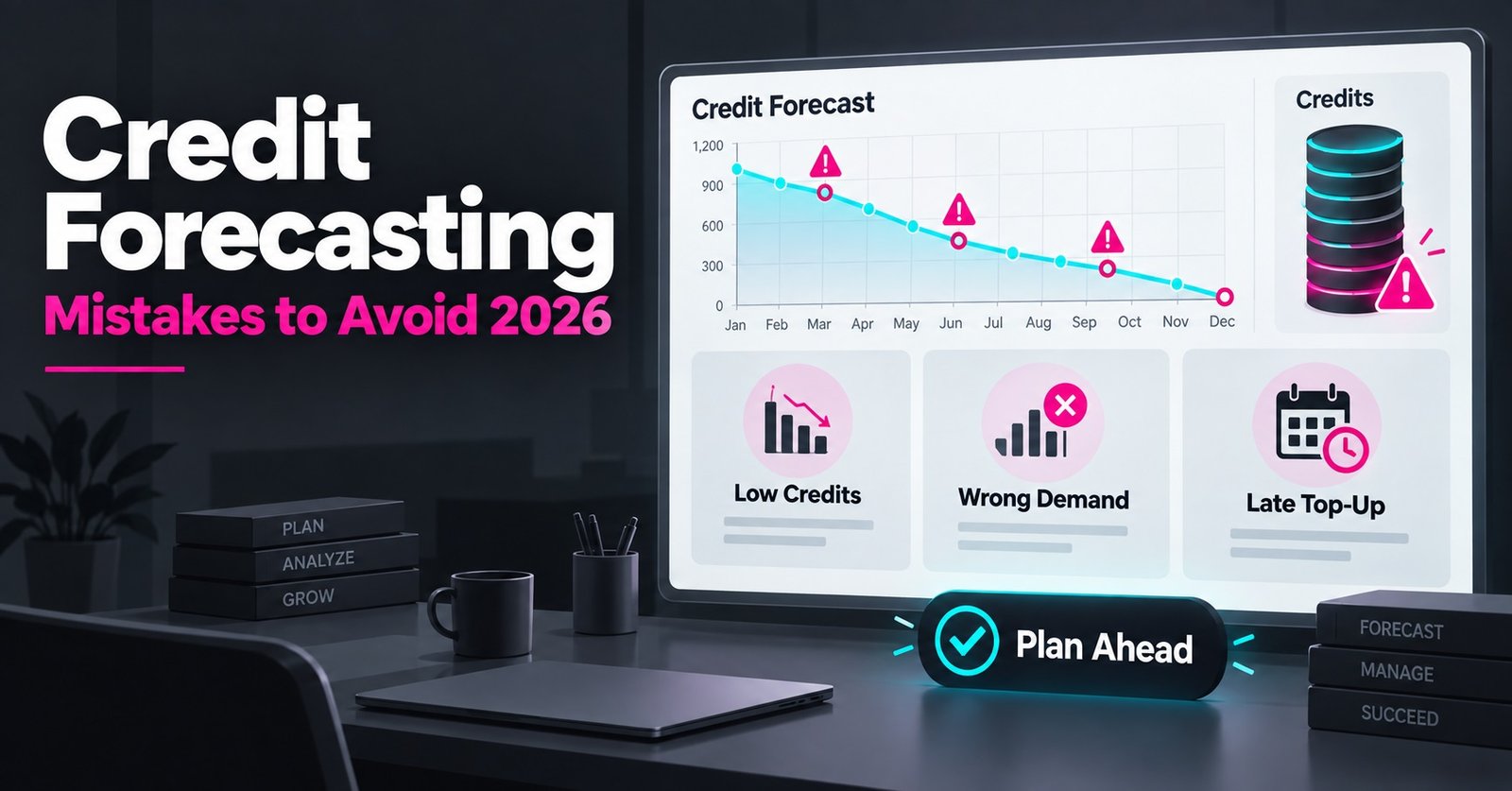

IPTV Reseller Credit Forecasting is the habit of working out how many credits your panel will consume before your next top-up arrives, then ordering ahead of that number rather than reacting to a low balance. The calculation only needs four things: how fast you are currently spending credits, how many subscriptions fall due for renewal in the period, how long your supplier realistically takes to load a top-up, and how much buffer you keep for the orders you cannot predict. Get those four right and the balance in your dashboard stops being a source of anxiety.
The mistake worth avoiding early is watching the balance instead of the burn. A balance of forty credits means nothing on its own. If eleven customers renew next week and two of them want twelve-month plans, forty credits is already gone. Before you do anything else, open your panel and look at the expiry list rather than the credit counter, because that list is the closest thing you have to a bill you have not yet been shown.
Why the Balance Figure Misleads Almost Every New Reseller
Credits behave like stock, not like cash in a bank account. Cash sits still. Stock gets committed long before it physically leaves the shelf, and credits work the same way: the moment a customer tells you they want a year, twelve credits are spoken for even though the panel has not deducted them yet.
That gap between committed and deducted is where most IPTV panel resellers get caught. They look at a healthy-looking balance on a Tuesday, feel comfortable, and then find themselves messaging their supplier at eleven at night on Friday because three renewals and a new sale landed in the same evening. Nothing went wrong operationally. The number they were watching simply had no predictive value.
The fix is to stop treating the balance as a status and start treating it as a countdown. A balance is only meaningful when you know how many days of trading it represents. Forty credits at a burn of four credits a week is ten weeks of cover. Forty credits at a burn of fifteen credits a week is under three weeks, and if your supplier takes two days to process a top-up, you are much closer to the edge than the number suggests.
Working Out Your Burn Rate Without Overcomplicating It
Burn rate is the number of credits leaving your panel per week or per month, counted in credits rather than customers. This distinction matters more than it sounds. Ten customers might cost you ten credits if they are all on monthly plans, or ninety if most of them took long-term subscriptions. Customer count tells you about your business. Credit count tells you about your stock.
Use a rolling average, not last month
One month is too small a sample for a reseller with a modest customer base. A single annual plan can double your apparent burn and make the following month look like a collapse. Take the last three months of credit spend, divide by three, and use that as your working monthly figure. Recalculate it at the start of each month so the average moves with the business instead of anchoring to an unusual period.
Separate the two kinds of spend
Split your burn into renewal spend and new-sale spend, because they behave differently and you predict them differently. Renewal spend is close to knowable, since the expiry dates already exist inside the panel. New-sale spend is a genuine forecast based on your recent sales pattern and whatever promotion you have running. Keeping them apart means a slow sales month does not corrupt your renewal planning, and a heavy renewal month does not make you think sales have suddenly surged.
Pro tip: Record credit spend in a simple sheet at the end of each week with two columns, renewals and new sales. Four weeks of that gives you a more reliable forecast than any amount of guesswork from memory.
Renewal Dates Are Already Telling You What Next Month Costs
Most panels let you filter or sort active lines by expiry date. That filter is the single most useful forecasting tool you have, and it is sitting unused in the majority of IPTV reseller dashboards. Pull every line expiring in the next thirty days, then add up the credits those customers would consume if they renewed on the same plan length they bought last time.
You will not get every renewal, so apply a renewal rate you can actually defend from your own records rather than an optimistic guess. If you have been trading long enough to know roughly what proportion of customers return, use your own figure. If you are too new to have one, forecast the full renewal load and treat any non-renewals as a bonus, because over-ordering credits on a non-expiring balance costs you nothing except the timing of the payment. Under-ordering costs you a customer.
There is a second pattern hiding in that expiry list: clustering. Resellers who launch with a promotion often sell a burst of subscriptions in the same fortnight, and those subscriptions then come back for renewal in the same fortnight every cycle. If you can see a cluster building, you can either pre-order credits ahead of it or deliberately stagger new sign-ups by offering slightly different plan lengths, which smooths the load over time. Understanding how the reseller panel workflow runs end to end makes those expiry filters far easier to use properly.
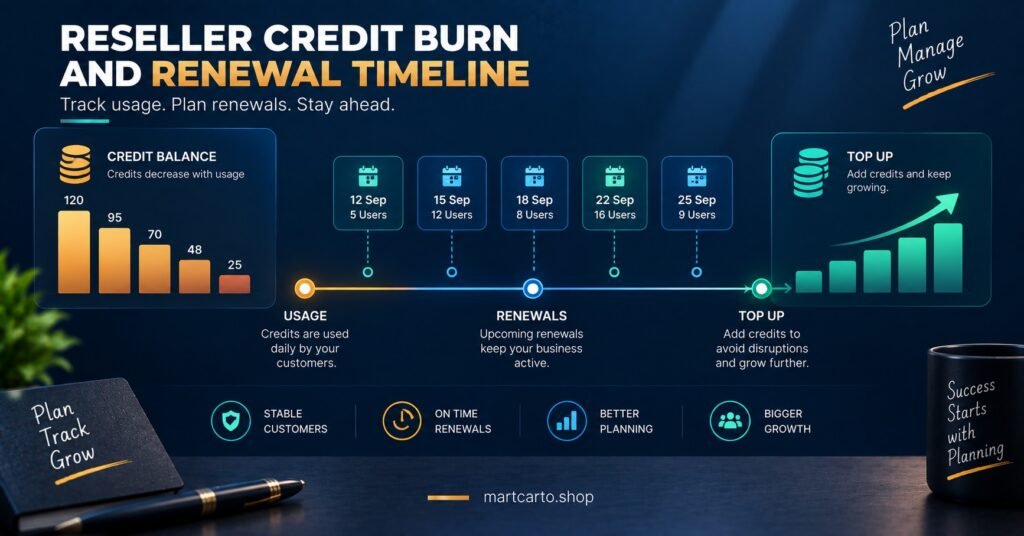
The Four Inputs Behind IPTV Reseller Credit Forecasting
Once you have burn rate and renewal load, the model comes together quickly. Everything you need fits into four lines, and the example figures below are purely illustrative, meant to show the shape of the calculation rather than to describe any particular business.
| Forecast input | Example figure | Where the number comes from |
|---|---|---|
| Renewals due next month | 28 credits | Expiry filter inside the panel |
| Expected new sales | 14 credits | Three-month rolling average |
| Lead time cover | 7 credits | Daily burn multiplied by supplier lead time |
| Safety stock | 15 credits | Largest plausible single order plus a week of burn |
Add those together and the example reseller needs roughly sixty-four credits available at the start of the month, not the forty-two that renewals and new sales alone suggest. The last two rows are the ones people leave out, and they are the reason a forecast that looked correct on paper still ends with an empty panel on a Saturday night.
The model is deliberately crude. It does not need regression analysis or a complicated spreadsheet. It needs you to write four numbers down once a month and top up before the balance falls through the total of the bottom two rows.
Lead Time Decides When You Order, Not How Much
Quantity and timing are separate decisions, and resellers who conflate them end up holding plenty of credits at exactly the wrong moment. Lead time is the gap between deciding to top up and the credits actually appearing in your panel, and it is almost never the number your supplier quotes in ideal conditions.
Realistically it includes the time it takes you to notice you need credits, the time to send payment, the time for that payment to clear or be confirmed, and the supplier’s own processing window. Add a weekend or a public holiday and a two-hour top-up can become a two-day one. Bank transfers behave differently from instant payment methods, and a first-time order with a new supplier usually takes longer than a repeat one.
Your reorder point is simply daily burn multiplied by realistic lead time in days, plus your safety stock. When the balance touches that figure, you order, regardless of how comfortable the number still feels. Treating it as a trigger rather than a judgement call removes the decision from the moment you are least able to make it well.
Pro tip: Time your next two top-ups from the moment you send payment to the moment credits appear, then use the slower of the two as your planning lead time. Suppliers vary, and the honest way to check whether a supplier is worth relying on is to measure them rather than trust the sales page. The same principle applies when you are assessing what makes a reseller panel reliable in the first place.
Sizing Safety Stock Around Your Biggest Single Order
Safety stock exists to absorb the order you did not see coming. For most UK IPTV resellers the dangerous event is not a busy week, it is one customer asking for a long plan at short notice. A single twelve-credit subscription can clear out a modest buffer on its own, and refusing or delaying that sale while you wait for a top-up is a poor way to start a customer relationship.
A workable rule is to hold enough credits to cover your largest realistic single order plus about a week of normal burn. If you regularly sell annual plans, that means keeping meaningfully more in reserve than a reseller who only sells monthly. If your customers almost always buy month to month, your buffer can be much smaller and your capital stays free for other parts of the business.
Where credits do not expire, holding a buffer is low risk, since unused balance keeps its value and simply waits for the next sale. It is worth confirming that policy with your supplier before you build a strategy around it, because a balance that quietly expires turns prudent stock-holding into wasted money. Checking the credit pack sizes and top-up pricing also helps you decide whether one larger pack or several smaller top-ups suits your cash position better, since pack pricing and your forecast interact more than most resellers expect.

The Months That Break an Otherwise Sensible Forecast
Averages work until demand moves, and demand in this business moves for predictable reasons. The start of a major live sport season tends to pull in new subscribers and push existing ones towards longer plans. Colder months generally see more viewing hours and more sign-ups than the middle of summer. Any promotion you run yourself creates its own spike, and then creates a matching renewal spike a year later.
None of that requires a complicated seasonal model. It requires you to look at your forecast and ask whether anything in the coming month is different from the three months you averaged. If the answer is yes, raise the new-sales line by a sensible margin and order accordingly. A modest over-order on a non-expiring balance is a timing inconvenience. An under-order during your busiest fortnight is lost revenue that does not come back.
The reverse also applies. If you have deliberately paused marketing or you are between promotions, your rolling average will overstate what you need, and there is no virtue in tying up money in stock you will not touch for two months. Forecasting is as much about not over-buying during quiet periods as it is about covering busy ones, and it becomes far more accurate once you have a settled routine for selling subscriptions consistently rather than in unpredictable bursts.
What Running Out Mid-Month Actually Costs You
The direct cost is obvious enough: a customer wants to pay and you cannot serve them immediately. The indirect costs do more damage. A renewal that lapses because you had no credits leaves the customer without service on a day they expected it to work, and from their side that looks like an outage, not an administrative issue. Some of them will not wait for an explanation.
There is also a quieter cost in how it changes your behaviour. Resellers who have been caught short once tend to over-correct, buying large packs at moments when cash is tight, or accepting whatever a supplier offers simply because they need credits quickly. Neither is a good position to negotiate from. Keeping a reorder point is partly about service, but it is also about never being the buyer who has no choice.
Common Questions About Credit Planning
How often should I recalculate my forecast?
Once a month is enough for most resellers, ideally on the same day each month so it becomes routine. Recalculate sooner if you run a promotion, add a noticeably large customer, or change your plan lengths.
What if I am brand new and have no sales history to average?
Forecast renewals at full value and assume new sales will be lumpy rather than steady. Start with a buffer sized to two or three of your longest plans, then replace the guesswork with real figures after your first eight to twelve weeks of trading.
Does selling mostly annual plans change the model?
Yes, in two ways. Your monthly burn becomes far less even, so a rolling three-month average matters more, and your safety stock needs to be larger because one sale consumes so much. The trade-off is that your renewal calendar becomes easier to see a year ahead.
Should I forecast in credits or in currency?
Forecast stock in credits, because that is the unit the panel actually deducts. Convert to currency only when you are deciding which pack to buy and when the payment needs to leave your account.
How do I forecast for sub-resellers under my account?
Treat each sub-reseller as a demand stream in its own right rather than folding them into your own burn rate. Ask them for their expected volume, apply a discount to whatever they tell you, and remember that their sales spikes arrive with almost no warning from your side.
Bringing It Together
IPTV Reseller Credit Forecasting is not a spreadsheet exercise, it is a stock-control habit that takes about ten minutes a month. Four numbers, written down: what renewals are due, what new sales you realistically expect, how long your supplier takes, and how much buffer your plan mix demands. Order when the balance touches the total of the last two, not when it looks low.
It will not be exact, and it does not need to be. The purpose is to make running out a rare and recoverable event rather than a monthly scramble. If you only take one action from this, open your panel now, sort your active lines by expiry date, and total the credits due in the next thirty days. Most IPTV panel resellers find that number is larger than they assumed, and that discovery on a quiet weekday is a great deal cheaper than making it on a Saturday night.
Credit Stock Control Checklist
- Sort active lines by expiry date and total the credits due in the next 30 days
- Work out your rolling three-month credit burn, split into renewals and new sales
- Time your last two top-ups from payment sent to credits received, and use the slower figure
- Set a reorder point of daily burn multiplied by lead time, plus your safety buffer
- Size the buffer around your largest plausible single order rather than your average one
- Check whether your supplier’s credits expire before relying on a held balance
- Flag any promotion or seasonal push in advance and raise the new-sales line accordingly
- Re-run the four numbers on the same day every month so it stays a routine rather than a reaction