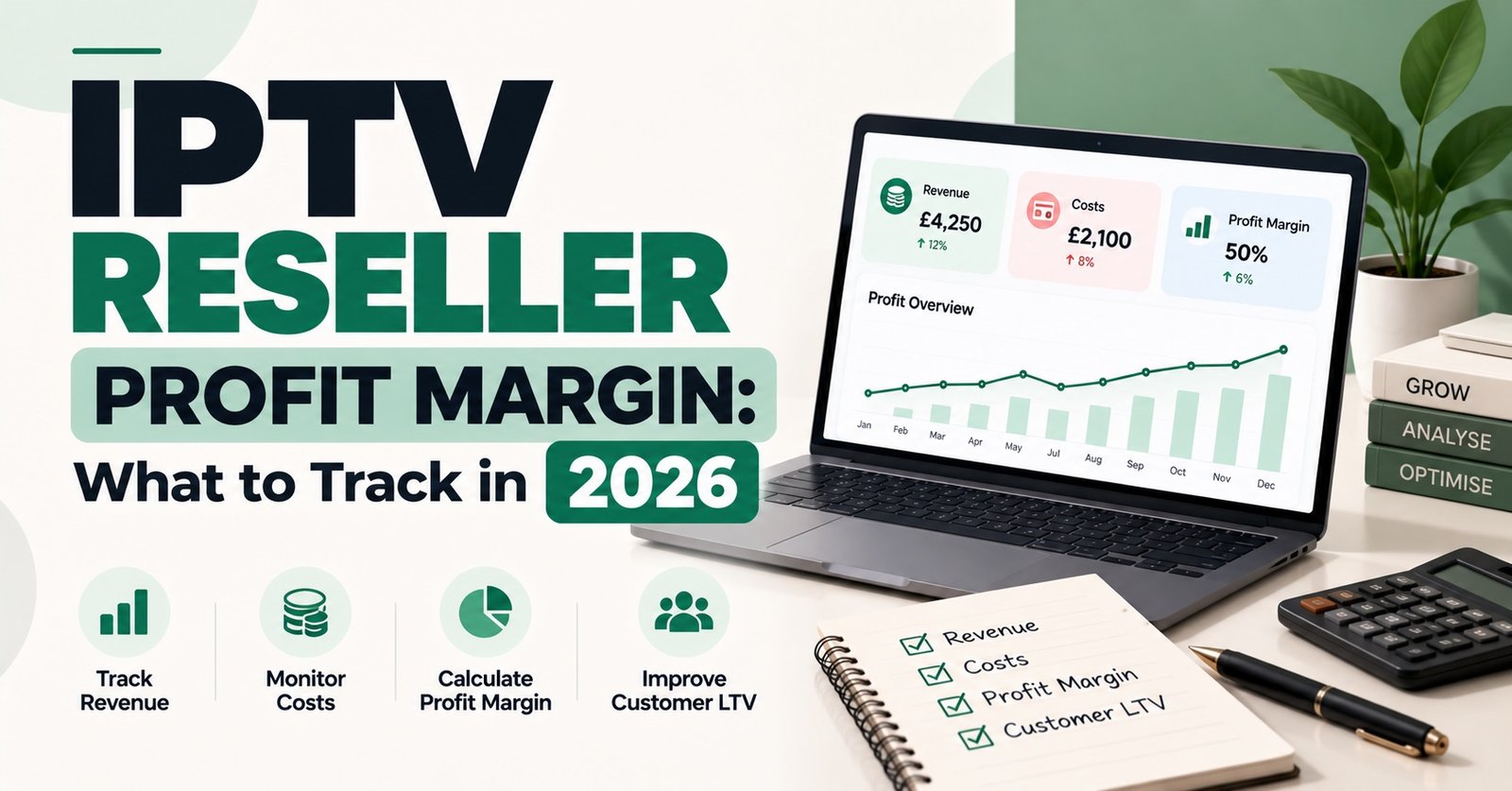

IPTV Reseller Profit Margin is the share of each customer payment you keep once credit cost, payment fees, refunds and support time have come out. For most small operations it is noticeably lower than the gap between credit price and selling price suggests.
So the first job is to stop trusting a single number. A comfortable-looking gap on a sale disappears quickly once a refund, a failed renewal and a long setup conversation are paid for out of it. Track margin per customer and per plan type rather than as one monthly total, and the weak spots show up much sooner.
Why a good-looking credit gap still misleads
Most IPTV resellers panels price from two numbers: what a credit costs them and what the customer pays. The gap between those is markup or gross margin. It is the easiest figure to calculate and the least safe to rely on.
Markup is measured against cost, margin against the selling price, so one sale produces two different percentages. Buy a credit at £2.00 and sell a month of service at £3.00, and the markup is 50% while the margin is 33%. It is easy to quote the bigger figure and then plan around it.
Neither figure knows what happens after the sale. A twelve-month customer is not one transaction. It is a payment, a setup conversation, perhaps a replacement line, a renewal reminder and a second payment. Each step has a cost, and the credit gap ignores all of them.
Four measures, four different questions
These four terms get used interchangeably, but each answers something different.
| Measure | What comes off the selling price | What it tells you |
|---|---|---|
| Gross margin | Credit cost only | Whether your pricing against the supplier is sound |
| Contribution margin | Credit cost, payment fees, refunds, replacements, support time | What each customer genuinely adds |
| Net margin | Everything above plus shared overheads such as tools, storefront, bank charges and tax | Whether the business as a whole earns money |
| Profit per customer | The same costs as net margin, shown in pounds over the plan term | Whether adding customers helps or only adds work |
Contribution margin is the one to manage week to week. It decides whether one more customer on a given plan is worth taking. Gross margin is a pricing check against your supplier, and net margin belongs to the month-end review.

Which credit price goes into the sum
If you buy packs at different prices, “credit cost” can mean three things: what you paid for the pack you started with, the weighted average across your current balance, or what the next top-up will cost. Pick the right one for the job.
For tracking margin, use the weighted average. Suppose 100 credits cost £2.00 each and a later 50 cost £1.60 each. That is £280 spread over 150 credits, or about £1.87 per credit.
For pricing decisions, use replacement cost, because that is what you will pay when stock runs out. A reseller still spending cheap old credits at an old selling price can look profitable until the next restock. Check current tiers on the IPTV reseller panel prices page before you restock, since a bulk tier changes your average.
Working out IPTV Reseller Profit Margin for one customer
The figures below are invented purely to show the arithmetic. Replace each line with your own records.
- Selling price for a 12-month plan: £60
- Credit cost, 12 credits at £2.00: £24
- Payment fee: £2
- Refund and replacement allowance, spread across all customers: £3
- Support time, 45 minutes over the year at £12 an hour: £9
- Share of overheads: £2
Gross margin is £36 on £60, or 60%. Contribution is £22, about 37%. After overheads, profit per customer is £20, or 33%. The distance between 60% and 33% is where your pricing decisions actually sit.
To fill in the allowance honestly, take the credits refunded or reissued in the last quarter and divide by customers sold in the same period. For support, log the time you spend per customer for a fortnight, even roughly.
Pro tip: Value your own time at a fixed hourly rate even if you pay yourself nothing. Otherwise a plan that eats your evenings will always look profitable.
Some costs get left out because they are not tied to a single sale: storefront hosting, helpdesk tools, bank charges and tax. If you handle any cost connected to making sure the content you sell is properly authorised, include that too. IPTV is a delivery technology, and whether a service is lawful depends on rights, permissions and local rules, so compliance cost belongs in the sum.
Where the margin quietly drains away
Refunds and replacement credits
A refund rarely returns the credit you already spent, and it usually loses the payment fee as well. A replacement line costs credits again. Your own refund promise should not be more generous than the cover you get upstream, so read the supplier terms, and compare them with the Martcarto refund policy to see how cover is described in practice.
Support labour
Setup chats, device questions and “it was working yesterday” messages are real hours. A customer on a short, cheap plan who needs three conversations may cost more than they pay. Recurring stream problems are a margin issue as much as a service issue, which is why it helps to know what to check in reliable IPTV reseller panels before you commit stock to one.
Payment leakage
Discounts agreed in chat, renewals extended before payment arrives, reversed or failed payments, currency conversion differences and manual transfers that need reconciling all chip away at the price you thought you charged. The credit is gone the moment a line is created, so create or extend lines only after payment has cleared.
Trials and dead credit
Test lines that never convert and lines that lapse after one term both consume credits without earning. Count trials as customer acquisition cost. Where credits do not expire, an unused balance is not wasted, but it is cash sitting idle and exposed to a supplier price change.
Averages hide the customers who cost you money
A blended margin can look healthy while one group of customers loses money and another carries it. Split your records by plan length, connection limit, region or panel tier, how the sale was made, and new versus renewing customers.
Plan length deserves particular attention. Payment fees and setup support are mostly fixed per sale, so a one-month customer pays them for one credit while a twelve-month customer spreads them across twelve. Short plans therefore need a higher price per month to earn the same margin.
If you also sell credits onward to sub-resellers, treat them as a separate line. Your margin there is smaller per credit, but support load is usually lower, so compare them on profit per hour of your time as well as per credit. For help structuring offers, how to sell IPTV reseller panel subscriptions covers the sales side.

Setting a price floor you can defend
Once you know your per-customer costs, you can work backwards to the lowest price you will accept:
Minimum price = total cost per customer ÷ (1 minus target margin)
Using the example above, costs come to £40 (24 + 2 + 3 + 9 + 2). With a 30% target margin, the floor is £40 ÷ 0.7, about £57.14. Selling at £60 clears it.
This also shows what a discount really costs. Dropping the price from £60 to £50 cuts profit from £20 to £10, so a discount of roughly one-sixth halves the profit. Discounts feel small in the moment and are large in the ledger.
Pro tip: Write the price floor down for each plan and decide in advance who can authorise going below it, even if that person is only you.
Quick answers on reseller margin
What is a good IPTV reseller margin?
There is no reliable published benchmark, and any single figure would ignore your credit cost, plan mix and support load. Use your own contribution margin and make sure it stays positive in your worst recent month.
Is markup the same as margin?
No. Markup is profit as a percentage of cost, margin is profit as a percentage of the selling price. The same sale gives a higher markup figure than margin figure.
Should my own time be included?
Yes. Unpaid hours are still a cost, and leaving them out hides which plans are not worth selling.
How often should I recalculate?
Monthly as a routine, and straight away when supplier pricing, your payment method or your refund terms change.
Monthly Margin Review Checklist
- Update your weighted average credit cost after every restock
- Compare it with the replacement cost of the next top-up
- Count refunds and replacement credits issued this month
- Total the support time logged, valued at your hourly rate
- Reconcile payments received against lines created or extended
- Count trial lines and how many converted to paid
- Recalculate contribution margin for each plan length
- Flag any plan that fell below its price floor and decide what changes
Where this leaves your numbers
Your IPTV Reseller Profit Margin is whatever remains after credits, fees, refunds and the time you spend keeping customers working. It will almost always be lower than the credit gap, and that is normal. What matters is knowing by how much, and on which plans.
The sensible next step is small. Pick your most common plan, fill in the six lines from the worked example with your own records, and see whether the result clears the price floor you would set. If it does not, fix pricing or support load on that plan first, before chasing more customers. Bear in mind that estimates such as the refund allowance will be rough at first and improve as your records build up.